2013年9月18日水曜日

Devious the Official Nuclear Syndicate

日本の原子力関係機関等で、よこしまな ,邪悪な官吏等が公然と暗躍して、国体が傾いてきている。

このようなよこしまな者達を放任していてはならない。

in Japanese atomic energy-related organizations,
wicked public employees act secretly, and the national polity inclines.

We must not let such the wicked people alone.

悪徳政治家。悪徳行政官僚。彼らを追放せよ。

The highbinder politicians.  

The corrupt administrative bureaucrats.
Let's expel them.

原子力行政に群がる悪徳政治家悪徳行政官僚を追放せよ。

Expel corrupt the highbinder politicians and the administrative bureaucrats gathering around the atomic energy government.


1/3『経団連会長』売国・守銭奴の住友化学(米倉弘昌)を糾す  


アップロード日: 2011/10/04
再生リスト http://www.youtube.com/playlist?list=...
西村修平 児島謙剛 まきやすとも
平成23年10月4日
説明『西村修平ブログ』http://nipponism.net/wordpress/
説明 http://www.shukenkaifuku.com/KoudouKa... 
主権回復を目指す会 http://www.shukenkaifuku.com/
主権回復を目指す会 政経調査会

==============================================================

2012.10.03 武田邦彦 福島県の「秘密会議」と出席した人たちの


公開日: 2012/10/02
武田教授のブログに、「福島県の「秘密会議」と出席した人たちの犯罪性」というコメン­トが「音声」で上がりましたので、アップしました。
元ブログ
「福島県の「秘密会議」と出席した人たちの犯罪性」→http://takedanet.com/2012/10/post_eba...
です。

以下、ブログから引用します。
-----
明石真言 放射線医学総合研究所理事
阿部正文 福島県立医科大学理事兼副学長(教授)
春日文子 日本学術会議副会長(国立医薬品食品衛生研究所安全情報部長)
神谷研二 広島大学原爆放射線医科学研究所長・教授(公立大学法人福島県立医科大学副学長)(福­島県放射線健康リスク管理アドバイザー)
菅野裕之 福島県保健福祉部長
児玉和紀 放射線影響研究所主席研究員
佐藤敏信 環境省環境保健部長
星 北斗 福島県医師会常任理事 .
安村誠司 福島県立医科大学医学部 公衆衛生学講座主任(教授)
山下俊一 福島県立医科大学副学長(福島県放射線健康リスク管理アドバイザー)
-----
です。
 
==============================================================

 福島原発内部告発者の東電トラブル隠し事件 Kei Sugaoka GE/Tepco


アップロード日: 2011/05/04
Kei Sugaoka the GE/Tepco Whistleblower (Subtitles provided)

On June, 2002 one man forced the shutdown of 17 reactors in Fukushima and Niigata in Japan. The reason was a reactor damage cover-up that was denounced by nuclear engineer Kei Sugaoka. Sugaoka a Japanese-American, back then a GE engineer who was in charge of the inspection and repairs of nuclear reactors became aware of several structural damages in a Fukushima reactor. However, he was told by TEPCO and GE to cover-up the damage and erase all the evidence about it. In response he submits a report of the irregularities to the Ministry of Trade and Industry in Japan which after further investigation unveil a total of 29 cover-up cases. This whistleblow scandal in the industry forces the temporary shutdown of 2 nuclear plants in Fukushima and Niigata and a complete restructuring in the nuclear industry in Japan.
The video are the clips of two japanese TV shows aired in summer of 2003 that document the cover-up incident.

Full article here at Criticality.org:
http://bit.ly/jjoP1P

内部告発 東電のトラブル隠し
アメリカのGE電力社の技術者スガオカ氏は2000年に内部告発をしました。内部告発­のきっかけは2002年に福島と新潟にある17機の原発全て停止されました。
スガオカ氏の内部告発はトータル原発の29件のトラブル隠しを告発をしました。
このビデオは2003年に日本のTBSとJNNチャネルで放送されました。
http://criticality.org/whistleblower-...

==============================================================

http://rt.com/op-edge/fukushima-catastrophe-nuclear-olympics-883/

Endless Fukushima catastrophe: 2020 Olympics under contamination threat


Dr Helen Caldicott is one of the most articulate and passionate advocates of citizen action to remedy the nuclear and environmental crises.
Published time: September 15, 2013 11:06
AFP Photo / TEPCO
AFP Photo / TEPCO
As the escape of radiation at Fukushima seems virtually unstoppable, there are still steps that governments all over the world should take to prevent worst case consequences. One of them would be canceling the 2020 Olympics in Tokyo.
Scientific estimates predict that the radioactive plume travelling east across the Pacific will likely hit the shores of Oregon, Washington State and Canada early next year. California will probably be impacted later that year. Because the ongoing flow of water from the reactor site will be virtually impossible to stop, a radioactive plume will continue to migrate across the Pacific affecting Hawaii, North America, South America and eventually Australia for many decades.
We are only talking about ocean currents, however, fish swim thousands of miles and don’t necessarily follow the currents. As noted in Part I, big fish concentrate radiation most efficiently, and tuna have already been caught off the coast of California containing cesium from Fukushima. Seaweed also efficiently concentrates radioactive elements.
As I contemplate the future at Fukushima, it seems that the escape of radiation is virtually unstoppable. The levels of radiation in buildings 1, 2 and 3 are now so high that no human can enter or get close to the molten cores. It will therefore be impossible to remove these cores for hundreds of years if ever.

Buildings 1, 2 & 3

If one of these buildings collapses, the targeted flow of cooling water to the pools and cores would cease, the cores would become red hot and possibly ignite releasing massive amounts of radiation into the air and water and the fuel in the cooling pools could ignite. It is strange that neither the US government in particular nor the global community seem to be concerned about these imminent possibilities and exhibit no urge to avert catastrophe.
Similarly the global media is strangely disconnected with the ongoing crisis. Most importantly, the Japanese government until very recently has obstinately refused to invite and collaborate with foreign experts from nuclear engineering companies and/or governments.

Building 4

This structure was severely damaged during the initial quake, its walls are bulging, and it sank 31 inches (79cm) into the ground. On the roof sits a cooling pool containing about 250 tons of hot fuel rods, most of which had just been removed from the reactor core days before the earthquake struck. This particular core did not melt because TEPCO was able maintain a continuous flow of cooling water, so the rods and their holding racks are still intact, but geometrically deformed due to the force of the hydrogen explosion. 
The cooling pool contains 8,800 pounds of plutonium plus over 100 other highly radioactive isotopes. Instead of this core melting into a larval mass like the other three cores, it sits exposed to the air atop the shaky building. A large earthquake could disrupt the integrity of the building, causing it to collapse and taking the hot fuel rods with it. The cooling water would evaporate and the intrinsic heat of the radioactive rods would ignite a fire as the zirconium cladding reacted with air, releasing the radioactive equivalent of 14,000 Hiroshima-sized bombs and 10 times more cesium than Chernobyl.

AFP Photo / TEPCO
AFP Photo / TEPCO

Not only would the Northern Hemisphere become badly contaminated, but the Japanese government is seriously contemplating evacuating 35 million people from Tokyo should this happen. TEPCO has constructed a steel frame to strengthen the shaky building in order to place a massive crane on the roof so they can extract the hot rods by remote control. This operation is always performed by computer and a remote manually-controlled extraction has never been attempted before. If the rods are deformed, a rod could fracture releasing so much radiation that the workers would have to evacuate or, should they touch each other, a chain reaction could release huge amounts of radiation.
I defer to Arnie Gundersen, a nuclear engineer in whom I have great faith. He says that a 2-meter thick zeolite wall should be constructed some distance from the reactors on the mountainside, which would effectively absorb the cesium from the water surrounding the reactor cores so it could not get out and further pollute the pure water descending from the mountain. At the same time, channels must be constructed to pump and divert the unpolluted mountain water into the sea. Then the three molten cores and their associated buildings could be immersed in concrete as the Soviets did at Chernobyl, and the situation could possibly be neutralized for about 100 years. What our poor descendants will then decide to do with this radioactive rubbish dump is beyond my comprehension.
However, as one Japanese official said, “If we just buried them no one would look at another nuclear plant for years.” An interesting reaction, so it is perfectly obvious that despite the calamity, they still want to pursue the nuclear option.
North America and Canada the EPA should immediately start monitoring the fish routinely caught off the west coast and it must also, as a matter of urgency, establish many effective airborne monitors up and down the west coast and across the US continent, so that if there is another large release of radiation it will be effectively measured and the information rapidly passed on to the public. The same holds true for Canada.
The US and Canadian governments must forthwith ban imported food from Japan, unless each batch is monitored for contamination, and the food grown in the US and Canada needs to be effectively monitored pending another major accident. The US has allowed food measuring up to 1,200 Becquerels per kilo to be sold in the US from Japan, while the Japanese allowable concentration for food is only 100 Becquerels per kilo. What does the US government think it is doing purposely exposing people to radioactive food? This situation must be urgently amended.

An aerial view shows the Tokyo Electric Power Co.'s (TEPCO) tsunami-crippled Fukushima Daiichi nuclear power plant and its contaminated water storage tanks (top) in Fukushima, in this photo taken by Kyodo August 31, 2013.(Reuters / Kyodo)

Nuclear Olympics

Given these impending problems, how can Japanese Prime Minister Abe possibly say that Tokyo will be safe for the Olympics? He actually said that “there is absolutely no problem” and “the situation is under control.” Does he not understand that parts of Tokyo are already radioactively contaminated and that his government is dumping ashes from the incineration of thousands of tons of radioactive debris from the tsunami and earthquake into Tokyo Bay? Is this what the athletes will be swimming in?
What if there is another major release of radiation before the Olympics? Young fit people who have spent years in rigorous training must, under no circumstances be exposed to radioactive air, food or water. And how can Abe possibly consider spending all that money housing people in expensive accommodation and constructing stadiums etc. when his own people - 160,000 Fukushima refugees - live in shacks and millions still live in highly radioactive zones and when the Fukushima complex is out of control?

==============================================================

undermine:

https://twitter.com/BarackObama

Barack Obama ‏@BarackObama  
A government shutdown could undermine our recovering economy—say .
政府のシャット ダウンは、景気の回復を損なう可能性がある- #EnoughAlready
と言います。

A government shutdown 政府機能停止

==============================================================

http://ejje.weblio.jp/content/undermine

undermine:
http://ejje.weblio.jp/content/undermine

【動詞】
名声などを〉ひそかに[陰険な手段で]傷つける.

They will do anything to undermine their adversary's reputation. 彼らは相手の評判を傷つけるためには何でもやってのけるだろう.

(浸食作用で)〈…の〉根もと[土台]を削り去る.

undermine a wall 城壁の下に坑道を掘る.


=================================================================

http://ejje.weblio.jp/content/corrupt

corrupt:

【形容詞】

人・品などを〉堕落させる.

1
a
(道徳的に)堕落した頽廃(いは)した,不道徳な邪悪な.
 
 
b
わいろのきく,汚職の.

 
2
a
テキストなど〉(誤写改変などで)原形そこなわれた,間違いの多い.
 
a corrupt manuscript 原形そこなわれた写本.
 
b
言語が〉なまった転訛()した.
 
【動詞】
1


b
を〉(わいろで)買収する.
 
They have corrupted our police force. 彼らは我々の警察買収した.

2
a

b
言語を〉転訛()させる,なまらせる.
 
corruptly 【副詞】
 
corruptness 【名詞】
 
 
【語源】
 
ラテン語完全にされた」の (COR‐+rumpere 「破る壊す」); 【名詞】 corruption
 
 ==============================================================
 
よこしまな ,邪悪な

http://ejje.weblio.jp/sentence/content/%E3%82%88%E3%81%93%E3%81%97%E3%81%BE%E3%81%AA

not straightforward よこしまな

a devious trick よこしまな計略

devious character よこしまな人物

a perverted discussion よこしまな議論
 
an official that is corrupt よこしまな官吏

wicked よこしまな
 
 ==========================================================


 ==========================================================

Devious the Official Nuclear Syndicate
 
Devious an official in the Nuclear Organization

Corrupt the Nuclear Organization

$ヤマト姫の玉手箱


放射線医学総合研究所
 
 
独立行政法人放射線医学総合研究所(ほうしゃせんいがくそうごうけんきゅうじょ、National Institute of Radiological Sciences(NIRS))は、1957年昭和32年)に発足した放射線医学に関する総合研究所。
発足当時は科学技術庁所管の国立研究所。平成13年に、文部科学省所管の独立行政法人に改組された。
 
あくまで研究機関であり、医療機関ではない。 独立行政法人放射線医学総合研究所法第3条によれば、以下のとおり。
「放射線の人体への影響、放射線による人体の障害の予防、診断及び治療並びに放射線の医学的利用に関する研究開発(研究及び開発をいう。以下同じ。)等の業務を総合的に行うことにより、放射線に係る医学に関する科学技術の水準の向上を図ることを目的とする。」
放射線の生体影響と放射線障害の診断・治療、社会的対策、放射線や同位元素を用いた疾病の治療と診断などについての研究を行っていて、総務部等の事務部門、人材育成課の養成部門の他、以下の5つの研究センターが中心となり様々な放射線の影響や放射線の利用についての研究活動をしている。
 
*重粒子医科学センター:重粒子線治療の高度化及び普及化、生物学、物理工学的な研究開発
*重粒子医科学センター病院:同センターの病院部門
*分子イメージング研究センター:画像診断用の薬剤開発、脳神経研究、機器開発など先端技術の研究
*理化学研究所神戸研究所とともに、文部科学省が推進する分子イメージング研究プログラムの拠点として機能している。
*放射線防護研究センター:放射線の人体・環境への影響、その防護を目指した総合的な研究
*緊急被ばく医療研究センター:放射線による人体の障害に関する診断と治療に関する研究
*基盤技術センター:先端的な研究開発、実験動物の供給の他、研究設備の整備、安全業務

最終更新 2013年7月13日 (土) 01:42

 ==========================================================

http://www.nirs.go.jp/about/outline.shtml

放射線医学総合研究所
 
理事長 米倉 義晴(よねくら よしはる)
20110914100751.jpg

職務
研究所を代表し、その業務を総理する。
 
経歴
昭和55年7月
京都大学 医学部 助手 採用

平成2年6月
京都大学 医学部 助教授

平成7年5月
福井医科大学 高エネルギー医学研究センター 教授

平成15年10月
福井大学 高エネルギー医学研究センター 教授

平成16年4月
国立大学法人 福井大学 高エネルギー医学研究センター 教授

平成18年4月
現職

理事 明石 真言(あかし まこと)

職務
研究所を代表し、その業務を総理する。

経歴
昭和56年5月
自治医科大学内科ジュニアレジデント

昭和62年11月
米国カリフォルニア大学ロサンゼルス校医学部血液・腫瘍科研究員

平成2年4月
科学技術庁放射線医学総合研究所障害臨床研究部採用

平成4年6月
科学技術庁放射線医学総合研究所障害臨床研究部主任研究官

平成8年5月
科学技術庁放射線医学総合研究所放射線障害医療部室長

平成13年4月
独立行政法人放射線医学総合研究所緊急被ばく医療センター被ばく診療室長

平成15年3月
独立行政法人放射線医学総合研究所緊急被ばく医療研究センター被ばく医療部長

平成19年4月
独立行政法人放射線医学総合研究所緊急被ばく医療研究センター長

平成23年4月
現職


http://www.rerf.or.jp/intro/org/bod_list/niwa.html


丹羽 太貫

現 職
京都大学名誉教授
 
学 歴
1975年
スタンフォード大学院修了、Ph.D.
1972年
スタンフォード大学大学院入学(生物物理学専攻)
指導教官: Philip C. Hanawalt教授、Henry S. Kaplan教授
1967年
京都大学理学部卒業(動物学専攻)
京都大学大学院入学(動物学、放射線生物学教室加藤幹太教授)
 
職 歴
2011年 京都大学名誉教授
2009年 バイオメディクス株式会社代表取締役社長
2007年 独)放射線医学総合研究所重粒子医科学センター副センター長
1997年 京都大学放射線生物研究センター教授
1991年 広島大学原爆放射能医学研究所病理学教室教授
1984年 京都大学医学部放射線基礎医学教室助手
1975年 文部教官(広島大学助手 原爆放射能医学研究所)
 
受賞、栄誉及び学術活動
Roentgen賞(2005年)

国際貢献
国際放射線防護委員会(ICRP)第1委員会委員(2001-2009年)主委員会委員(2009年-)

学会役員等
国際放射線研究連合(International Association of Radiation Research)副会長・会長(2007-2011年)

主な論文・著書
Biken Journal 15, 39, 1972、J. Natl. Cancer Inst. 62, 329, 1979、、、Cell 32, 1105, 1983、J. Virol. 65, 2979, 1991、PNAS 98, 1705, 2001、Mol. Cell. Biol. 22, 2220, 2002、Nature Immunol. 4, 533-539, 2003、Mutat Res. 598, 61, 2006、他120編

==============================================================

原子力損害賠償紛争審査会 第1回会合(4月15日)


アップロード日: 2011/04/17
政府は15日、「原子力損害賠償紛争審査会」の初会合を開催し、福島第一原発の事故に­よる損害賠償の範囲を決める議論に入った。同審査会の開催については、傍聴の定員が5­0人の上、13日午前に開催を告知し、翌日14日の14時が締め切りだったことから、­フリーのジャーナリストや一般の市民などから苦情が上がった。

初会合では、まず、農業や漁業、運輸、観光など各産業ごとにどのような損害が出ている­のか、各省庁から報告が行われた。能見会長は、政府の指示で避難を余儀なくされた住民­について、避難の費用だけでなく精神的な苦痛なども賠償の範囲にするとした指針を提案­する意向を示した一方で、出荷制限や風評被害については、今後の検討課題とした。また­、放射能により健康被害の評価についても、委員の間で意見が分かれている。次回の会合­は22日午前の予定。

動画は後半の委員による議論(30分)。各省庁の報告(90分)を含めた原子力損害賠­償紛争審査会全編はニコニコ生放送でご覧いただけます。
http://live.nicovideo.jp/watch/lv4668...

原子力損害賠償紛争審査会
http://www.mext.go.jp/a_menu/anzenkak...

原子力損害賠償紛争審査会委員
◎能見 善久(学習院大学 法務研究科 教授)
大塚 直(早稲田大学大学院 法務研究科 教授)
鎌田 薫(早稲田大学総長、早稲田大学大学院 法務研究科 教授)
草間 朋子(大分県立看護科学大学 学長)
高橋 滋(一橋大学大学院 法学研究科 教授)
田中 俊一(財団法人 高度情報科学技術研究機構 会長)
中島 肇(桐蔭横浜大学 法科大学院 教授/弁護士)
野村 豊弘(学習院大学 法学部 法学科 教授)
山下 俊一(長崎大学大学院 医歯薬学総合研究科 研究科長)
米倉 義晴(放射線医学総合研究所 理事長)

==============================================================

福島県の県民健康管理調査の『秘密』検討委員会メンバー

http://ampakarima.exblog.jp/19215675

しっかりこの悪人達の顔を見てください. (福島県の県民健康管理調査の検討委員会で、事前に見解をすり合わせる「秘密会」のメンバー)写真.(URL Excite とリンクできません。)
http://kingo999.blog.fc2.com/blog-entry-892.html

… 原発事故とがん発生の因果関係を否定する秘密会議

いささかつるし上げの感が無きにしも非ずですが、福島県民に対する犯罪行為をした者たちを裁かねばなりません。

以下、正副県知事・秘密会議メンバー・秘密会議オブザーバーの順で名前・肩書き入りの写真を公開します。


ニュースでは取り上げられませんが、どうやら元凶は、佐藤雄平福島県知事のようです。

http://ja.wikipedia.org/wiki/%E4%BD%90%E8%97%A4%E9%9B%84%E5%B9%B3

Wikipedia と Excite がリンクできませんので、「佐藤雄平」で検索できます。

2 プルサーマル計画受け入れ
3 福島第一原子力発電所事故への対応 3.1 東京電力に「放射能による健康被害の心配はない」と発表するよう要請
3.2 福島県放射線健康リスク管理アドバイザーの委嘱
3.3 SPEEDI問題
3.4 安定ヨウ素剤投与指示について(いわき市と三春町は独自に安定ヨウ素剤の配布を行った)
3.5 事故は人災、の認識示さず

事故以前は、プルサーマル受け入れで、自民党国会議員と策謀をめぐらし、事故後は県民の健康を考えるどころか、被曝量を矮小化し、住民の流出をやっきになって止めている悪魔知事です。

このニュースでは村田文雄福島県副知事が前面に出ていましたが、裏で糸を引いていたのがこの男「佐藤雄平」に間違いありません。

私は福島県知事の「佐藤雄平」です。民主党最高顧問・「渡部恒三」の甥です。私がプルサーマル導入を決定しました。
「ごめんなさい」言いましたか?
東電に食いついてみたり、一見県民の味方ぶりっ子してますが、実は・・・嘘なんです。


私は福島健康調査「秘密会」のメンバーです。知事が隠れていますので、私が秘密会を行ったことを謝罪しました。「ごめんなさい、もう・・・しません」福島県副知事の「村田文雄」です。

「秘密会議の中心メンバーです。」

私は福島健康調査「秘密会」メンバーの座長、福島県立医科大学副学長(福島県放射線健康リスク管理アドバイザー)・長崎大学の「山下俊一」です。


私は福島健康調査「秘密会」のメンバー、広島大学原爆放射線医科学研究所長・教授(山下俊一と共に福島県放射線健康リスク管理アドバイザーをしている。)・広島大学の「神谷研二」です。


私は福島健康調査「秘密会」のメンバー、福島県保健福祉部長の「菅野裕之」です。


私は福島健康調査「秘密会」のメンバー、放射線影響研究所主席研究員の「児玉和紀」です。


私は福島健康調査「秘密会」のメンバー、環境省環境保健部長の「佐藤敏信」です。


私は福島健康調査「秘密会」のメンバー、日本学術会議副会長(国立医薬品食品衛生研究所安全情報部長)の「春日文子」です。


私は福島健康調査「秘密会」のメンバー、放射線医学総合研究所理事の「明石真言」です。


私は福島健康調査「秘密会」のメンバー、福島県立医科大学理事兼副学長(教授)の「阿部正文」です。


私は福島健康調査「秘密会」のメンバー、福島県医師会常任理事の「星北斗」です。


私は福島健康調査「秘密会」のメンバー、福島県立医科大学医学部 公衆衛生学講座主任(教授)の「安村誠司」です


ここからは「秘密会議のオブザーバーです。」


私は福島健康調査「秘密会」にオブザーバーとして参加していました。内閣府原子力災害対策本部原子力被災者生活支援チーム医療班参事官の「渕上善弘」です。


私は福島健康調査「秘密会」にオブザーバーとして参加していました。文部科学省科学技術政策研究所総務研究官の「伊藤宗太郎」です。


私は福島健康調査「秘密会」にオブザーバーとして参加していました。厚生労働省大臣官房厚生科学課健康危機管理官の「小澤時雄」です。


私は福島健康調査「秘密会」にオブザーバーとして参加していました。公立大学法人福島県立医科大学医学部 小児科学講座主任(教授)の「細矢光亨」です。


私は福島健康調査「秘密会」にオブザーバーとして参加していました。公立大学法人福島県立医科大学医学部 産科婦人科学講座主任(教授)の「藤森敬也」です。


私は福島健康調査「秘密会」にオブザーバーとして参加していました。公立大学法人福島県立医科大学医学部 器官制御外科学講座教授の「鈴木眞一」です。


私は福島健康調査「秘密会」にオブザーバーとして参加していました。公立大学法人福島県立医科大学医学部 放射線健康管理学講座教授の「大津留晶」です。


私は福島健康調査「秘密会」にオブザーバーとして参加していました。公立大学法人福島県立医科大学医学部 放射線生命科学講座教授の「坂井晃」です。


私は福島健康調査「秘密会」にオブザーバーとして参加していました。公立大学法人福島県立医科大学医学部 神経精神医学講座准教授の「矢部博興」です。

いかに罪深くても、小佐古敏荘内閣官房参与が、「20mSv/年」を強く批判して辞任したように、これらの方々もすべて、涙の記者会見をお願いします。福島県民と、全世界に向けて謝罪しなさい。そして、自ら退任し、その足で福島県警に自首しましょう。

それでも、県民への影響が少ないと主張されるなら、「私は秘密会議に出席したメンバーです。」と看板を持って堂々とお仕事をなさってください。

いいですか?正副県知事もですよ。

==============================================================

http://draft.blogger.com/blogger.g?blogID=4183788015120103681#editor/target=post;postID=102459188122537445;onPublishedMenu=allposts;onClosedMenu=allposts;postNum=0;src=link

2011年4月 1日 (金)

「原発被害に沈黙するWHO:IAEAの同意なしに発言できず」ル・モンド紙(3月19日)

日本で原発事故が起きて以来、世界保健機構(WHO)は驚くほど沈黙を守っている。まるで、日本政府と国際原子力機関(IAEA)からの情報を繰り返すだけで満足しているかのようだ。これは、WHOが1959年以来、IAEAからの合意がなければ原子力に関する健康問題に着手しないという協定を結んでいることに起因する。
WHOは3月14日に放射線や被爆した際の対応について文書をまとめたが、日本についてはたったの2パラグラフしか記載しなかった。更には、福島での原発事故が国民の健康に与える被害は少ない、とのみ記されている。
3月17日に改訂された同じ文書では、福島周辺で引き起こされている健康への脅威に触れず、「日本政府が提案した行動」を適切として承認している。
IAEAは核兵器以外での原子力の利用を推進するロビー機関である。従って、IAEAとのこうした関係は、WHOが独立した専門機関として機能するのを妨げている、と多くの関係者は考えている。
2つの機関が結んだ協定は、「両機関の利益に関する活動に着手する場合には、もう一方の機関の同意を得なければならない」と定めている。これは大概の場合、IAEAに有利に働く。
たとえば、2005年9月にWHOとIAEAが合同で取りまとめたチェルノブイリ原発事故の被害状況では他の多くの調査結果が無視され、死亡者50名、甲状腺の癌で亡くなった子ども9名、死亡に至る癌にかかった者は4000名、と結論がなされた。他方、2010年2月にニュー・ヨーク科学技術大学が実施した調査では、チェルノブイリ事故の関連で亡くなった人は98万5千人にまでのぼる、とされている。
アリソン・カッツは以前WHOの環境課に勤めていた。「WHO内でも、チェルノブイリの被害が過少に見積もられていることに対して落ち着かない気持でいる者が何人もいる」と言う。そして、日本のケースについてもまた同様のことが起こるのではないかと心配している。「IAEAが健康や退避の全般について決めている。」WHO本部には放射線防護の専門家が現在4名しかいない。
2007年には「独立したWHOを目指す会」が結成され、カッツ氏を含むメンバーが毎日WHO本部の近くでIAEAとの協定廃止を求めてデモを行っている。WHOは、ル・モンド紙がIAEAとの関係について質問したのに対し、これまでのところ回答を拒否している。
(Agathe Duparc, Le Monde, 20110319)


==============================================================

http://chibichan931.blog106.fc2.com/blog-entry-712.html

原子力村 神話の陰に―福島原発40年/朝日新聞
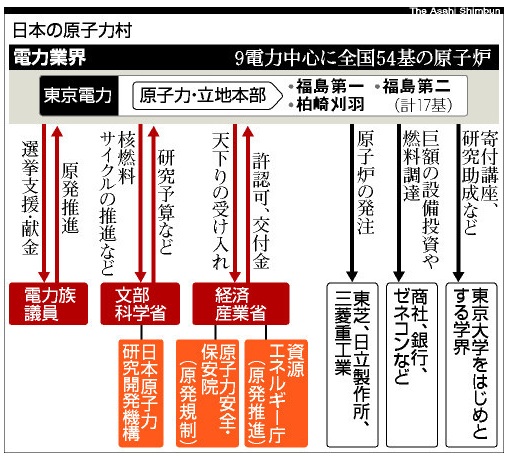
NCmura.jpg

東京電力の本社2階に、福島第一原発事故の政府・東電統合対策室(旧統合本部)がある。東電の内部資料に、4月17日午後7時から始まった全体会議のやり取りが記されている。
「吉田所長 レベル7で発電所の域を越えている。体制の抜本的な整備を」
「武黒 今までの応急的な事象とは異なった、懐の深い取り組みが必要」
「武藤 今後の道筋は、大きな方向を二つのステップで記載。大変盛りだくさんで未経験のもの」

事故収束へ向けた工程表を発表した日だった。発言者は福島第一原発所長の吉田昌郎(56)、副社長で原子力・立地本部長の武藤栄(60)、技術系最高幹部として社長を補佐する「フェロー」の武黒一郎(65)。武黒は武藤の前任者だ。福島の吉田はテレビ会議システムで参加していた。

チェルノブイリと同じ「レベル7」の大事故への対応に追われる武黒や武藤らは、東電原子力技術陣約3千人の最上部にいる。専門性のベールに覆われた原子力部門は、社内外から「原子力村」と呼ばれる。

9年前の2002年、村を揺るがす不祥事が起きた。原発の点検記録改ざんや虚偽報告などのトラブル隠しが発覚。原子力本部長の副社長と歴代社長4人が引責辞任に追い込まれた。

東電は「原子力部門の閉鎖性を打破する」と、再発防止に取り組む。新しい本部長には火力畑の副社長、白ト(トは土の横棒間の右側に「、」)良一(72)が就任。現会長の勝俣恒久(71)は、このとき社長になり、信頼回復を最優先に掲げた。原発の所長には広報部の幹部が就き、一般の見学を増やすなど開放に努めた。

だが、村の根本はいまも変わっていない。柏崎刈羽原発の所長だった武黒は、トラブル隠しの管理責任を問われて減給処分を受けたが、05年には白トの後任として原子力・立地本部長に就任。村のトップは原子力技術者に戻った。
白トは本部長当時、語っている。「火力と比べると手続きが多い。どこに働きかければいいのだろう。村長のいない『原子力村』に入り込んで迷っている感じだ」。原子力生え抜きの幹部は「他部門の人にはすぐには分からない。問題は17基も抱え、国の検査や説明に追われ、安全設計や事故を考える人がいなくなったことだった」と振り返る。

07年の新潟県中越沖地震。柏崎刈羽原発では変圧器で火災が発生。その後も火災は相次ぎ、本部長の武黒、副本部長の武藤、原子力設備管理部長の吉田は、減給処分を受ける。社内処分を何度受けようと、村の序列が崩れることはない。

今回の事故から約2カ月後の5月17日の記者会見。責任を聞かれた原子力本部長の武藤は「結果として大きな事故を起こして申し訳ない」と謝罪した。「結果として」の裏に「事故原因は想定外の地震・津波」との認識が見て取れる。6月に引責辞任するが、顧問として助言するという。

原子力村には、専門性のベールに加え、身内同士で固める殻で、社長も容易に手出しできない。経済産業省の元幹部は言う。「原子力部門は伏魔殿。そこを東電が支え、経済社会全体が支える構造になっている」。原子力村は東電の外にも広がっている。


■産・政・官・学……広大な「村」

東京電力の原子力部門の始まりは、1955年の原子力発電課発足にさかのぼる。手本は欧米の原子炉。「container(コンテナ)を格納容器と日本語に訳すには苦労した。格納庫では、ぴんと来ないし」。のちに原子力村の「ドン」と呼ばれる元副社長、豊田正敏(87)は懐かしむ。

課員は5人。60年、福島県への原発建設が決まり、豊田もかかわる。その原発がレベル7の事故を起こした。「非常用電源が津波で使用不能になったのは、設計に携わった米コンサルタント会社の配置がまずかったから。現場は気づかなかったのか。資金がかかるから言い出せなかったのか」。豊田は不思議がる。

東電は71年に運転を始めた福島第一原発1号機を皮切りに、高度成長期の電力需要をまかなおうと、原発建設に邁進(まいしん)。97年に運転を開始した柏崎刈羽原発7号機が17基目で、今年、久々に新規の東通原発1号機を本格着工する予定だった。

原子力部門は、いまや約3千人の技術者を抱える。原発の運転・維持費用は年間約5千億円。原発をもつ9電力だと、2兆円に迫る。日本原子力産業協会の会員には、重電メーカーや商社など400社以上が名を連ねる。原子力村は、東電内にとどまらず、政界、官界から学界、労働界をも巻き込む広大な世界だ。

原発は1基あたりの建設費が、3千億円とも5千億円ともいわれる。地域独占体制のもとでの安定した電気料金収入が、巨額の投資を可能にしている。

東電の元幹部は明かす。
いくら費用がかかっても、(コストに一定の利益を上乗せする)総括原価方式で電気代を上げることができる。だから、経営で大事なのは地域独占を守ること。その独占を持続できるように、各方面に働きかけることが本業になった

地域独占は、電力会社が送電網を支配しているからこそできた。90年代から2000年代初頭にかけ、この電力の地域独占を崩そうとする動きがあった。

東電を筆頭とする9電力は現代の幕藩体制。このままでは日本は高い電気代で競争力を失う」。経済産業省(旧通商産業省)の一部官僚が、電力自由化の旗を振った。旗頭は村田成二(66)。02年に事務次官に就き、今は新エネルギー・産業技術総合開発機構(NEDO)理事長を務める。

村田らは、電力会社から送電部門を切り離す「発送電分離」を最終目標に置く。総合資源エネルギー調査会の電気事業分科会を表舞台としつつ、電気事業法の改正案を練った。原発の国有化案もあった。

危機感を強めた電力業界は政治力を使う。「電力族」とされる衆院議員の甘利明(61)や、元東電副社長で参院議員の加納時男(76)=10年に議員引退=らは00年4月、自民党内にエネルギー政策の小委員会を旗揚げし、議員立法によるエネルギー政策基本法の制定を急いだ。

東電を休職中の秘書らが加納を支えた。法案の「安定供給の確保」という言葉には、発送電分離を阻むねらいが込められた。「原子力」の文字はないが、甘利は国会で「原子力は基本法の方針に即した優秀なエネルギー」と説明。法案の提出者には、後に官房長官になる細田博之(67)も名を連ねた。

基本法は02年6月に成立。しかし、2カ月後、電力業界で大きな不祥事が発覚する。東電の原発トラブル隠しだ。7月に次官に就いた村田は、会見で「独占供給を認めているのに期待値を裏切る」と憤った。東電は「村田が発送電分離を実現するために仕組んだのでは」といぶかった。

電力業界は窮地に追い込まれながらも、巻き返しに出る。族議員らが、電気事業分科会の自由化議論と並行して進んでいた政策導入に反対した。温暖化ガス抑制のための新たな石炭課税制度だ。村田らはやむなく、発送電分離を引っ込め、石炭課税を優先した。

族議員らは、エネルギー基本計画の策定への圧力も強めた。03年10月にできた計画には「原子力を基幹電源と位置づけ」「発電から送配電まで一貫」という文言が盛り込まれた。

04年夏、村田が退官すると、電力自由化の機運はしぼんでいく。甘利は06年、経産相に就いた。07年1月、電力各社で原発の法定検査データ改ざんが発覚したが、原子力安全・保安院は、経営責任を事実上、不問に付した。

産業界や族議員は3・11の事故後も、原発推進を声高に唱えている。敬称略(小森敦司)

*朝日新聞2011.5.25朝刊

==============================================================

(4回)低線量被ばくリスク管理 児玉龍彦教授 質疑応答⑦  


アップロード日: 2011/11/29
(4回)低線量被ばくのリスク管理に関するワーキンググループ
児玉龍彦 東京大学先端科学技術研究センター教授よりご説明 。
11/25 フルオープンにて開催。

撮影 六本木ヒルズ映像ジャーナリズム http://ameblo.jp/k-imai/

==============================================================

http://www.who.int/mediacentre/news/releases/2013/fukushima_report_20130228/en/

Global report on Fukushima nuclear accident details health risks

News release

A comprehensive assessment by international experts on the health risks associated with the Fukushima Daiichi nuclear power plant (NPP) disaster in Japan has concluded that, for the general population inside and outside of Japan, the predicted risks are low and no observable increases in cancer rates above baseline rates are anticipated.
The WHO report ‘Health Risk Assessment from the nuclear accident after the 2011 Great East Japan Earthquake and Tsunami based on preliminary dose estimation’ noted, however, that the estimated risk for specific cancers in certain subsets of the population in Fukushima Prefecture has increased and, as such, it calls for long term continued monitoring and health screening for those people.
Experts estimated risks in the general population in Fukushima Prefecture, the rest of Japan and the rest of the world, plus the power plant and emergency workers that may have been exposed during the emergency phase response.
“The primary concern identified in this report is related to specific cancer risks linked to particular locations and demographic factors,” says Dr Maria Neira, WHO Director for Public Health and Environment. “A breakdown of data, based on age, gender and proximity to the nuclear plant, does show a higher cancer risk for those located in the most contaminated parts. Outside these parts - even in locations inside Fukushima Prefecture - no observable increases in cancer incidence are expected.”
In terms of specific cancers, for people in the most contaminated location, the estimated increased risks over what would normally be expected are:
  • all solid cancers - around 4% in females exposed as infants;
  • breast cancer - around 6% in females exposed as infants;
  • leukaemia - around 7% in males exposed as infants;
  • thyroid cancer - up to 70% in females exposed as infants (the normally expected risk of thyroid cancer in females over lifetime is 0.75% and the additional lifetime risk assessed for females exposed as infants in the most affected location is 0.50%).
For people in the second most contaminated location of Fukushima Prefecture, the estimated risks are approximately one-half of those in the location with the highest doses.
The report also references a section to the special case of the emergency workers inside the Fukushima NPP. Around two-thirds of emergency workers are estimated to have cancer risks in line with the general population, while one-third is estimated to have an increased risk.
The almost-200-page document further notes that the radiation doses from the damaged nuclear power plant are not expected to cause an increase in the incidence of miscarriages, stillbirths and other physical and mental conditions that can affect babies born after the accident.
“The WHO report underlines the need for long-term health monitoring of those who are at high risk, along with the provision of necessary medical follow-up and support services,” says Dr Maria Neira, WHO Director for Public Health and Environment. “This will remain an important element in the public health response to the disaster for decades.”
“In addition to strengthening medical support and services, continued environmental monitoring, in particular of food and water supplies, backed by the enforcement of existing regulations, is required to reduce potential radiation exposure in the future,” says Dr Angelika Tritscher, Acting Director for WHO’s Food Safety and Zoonosis Department.
As well as the direct health impact on the population, the report notes that the psychosocial impact may have a consequence on health and well-being. These should not be ignored as part of the overall response, say the experts.
This is the first-ever analysis of the global health effects due to radiation exposure after the Fukushima NPP accident and is the result of a two-year WHO-led process of analysis of estimated doses and their potential health implications. The independent scientific experts came from the fields of radiation risk modelling, epidemiology, dosimetry, radiation effects and public health.

For more information please contact:

Glenn Thomas
WHO Communications Officer, Department of Communications
Telephone: +41 22 791 3983
Mobile: +41 79 509 0677
E-mail: thomasg@who.int
Nada Osseiran
WHO Communications Officer, Public Health and Environment
Telephone: +41 22 791 4475
Mobile: +41 79 445 1624
E-mail: osseirann@who.int

 ==============================================================

http://search.who.int/search?q=fukushima&ie=utf8&site=who&client=_en&proxystylesheet=_en&output=xml_no_dtd&oe=utf8&getfields=doctype

WHO | Global report on Fukushima nuclear accident details ...
A comprehensive assessment by international experts on the health risks
associated with the Fukushima Daiichi nuclear power plant (NPP) disaster
in Japan has concluded that, for the general population inside and ...
www.who.int/entity/mediacentre/news/releases/2013/fukushima_report_20130228/en/ - 28k
[News release]                  
 
WHO | Lessons from Fukushima: scientists need to ...
... Lessons from Fukushima: scientists need to communicate better. ... But,
for Fukushima, we don't have sufficient information on the size of dose
uncertainties to formally make allowance for them. ...
www.who.int/entity/bulletin/volumes/91/6/13-030613/en/ - 34k

WHO | The voice of the most vulnerable: lessons from the ...          ... The voice of the most vulnerable: lessons from the nuclear crisis
in Fukushima, Japan. ... First, the situation at Fukushima, with its
potential for future catastrophe, is a continuing one. ...
www.who.int/entity/bulletin/volumes/90/8/11-094474/en/ - 33k
[ More results from www.who.int/entity/bulletin/volumes ]
                                                    
... Q1. What is the Fukushima Dose Assessment Report and what is its aim? ... In
these two locations in the most affected part of Fukushima prefecture, the
effective doses were estimated to be within a dose band of 10–50 mSv. ...
www.who.int/entity/ionizing_radiation/pub_meet/faqs_dose_estimation/en/ - 31k

WHO | Frequently asked questions on health risk assessment          ... The health risk assessment aims to estimate the health risks related to radiation
exposure from the Fukushima Daiichi nuclear power station accident that
followed the Japan earthquake and tsunami on 11 March 2011. ...
www.who.int/entity/ionizing_radiation/pub_meet/faqs_fukushima_risk_assessment/en/ - 36k
[ More results from www.who.int/entity/ionizing_radiation/pub_meet ]
                                                      
WHO | East Japan earthquake and tsunami news archive
... East Japan earthquake and tsunami news archive. Countries discuss
public health impact of Fukushima. On Tuesday 17 ... other resources.
Update on Fukushima evacuation areas. 15 ...
www.who.int/entity/kobe_centre/emergencies/east_japan_earthquake/news_archive/en/ - 32k
 
... Q12. What happens next? The Dose Assessment Report forms one part of
an overall health risk assessment (to be published in summer 2012) by WHO
of the global impact of the accident at the Fukushima Daiichi NPP. ...
www.who.int/ionizing_radiation/pub_meet/faqs_dose_estimation/en/index2.html - 23k

WHO | Frequently asked questions          ... WHO established an International Expert Panel to make an initial assessment
of the possible range of radiation doses received by people in Fukushima
prefecture, other regions of Japan and worldwide as a consequence ...
www.who.int/ionizing_radiation/pub_meet/faqs_dose_estimation/en/index1.html - 26k
[ More results from www.who.int/ionizing_radiation/pub_meet/faqs_dose_estimation ]
                                                        
WHO | Public health round-up
... Fukushima assessment. ... For people in the second most contaminated part
of the Fukushima Prefecture, the estimated risks are approximately
one-half of those in the location with the highest doses. ...
www.who.int/bulletin/volumes/91/4/13-010413/en/ - 34k

... Travellers returning from Japan who have come from the 20 km evacuation
zone surrounding the Fukushima Daiichi nuclear power plant and who have
undergone proper screening and decontamination procedures, and ...
www.who.int/hac/crises/jpn/faqs/en/index3.html - 26k


 ==============================================================

http://www.who.int/ionizing_radiation/pub_meet/fukushima_risk_assessment_2013/en/index.html

2011 Great East Japan earthquake and tsunami, based on a preliminary dose estimation
Authors:
WHO

Book cover image

Publication details

Number of pages: 172
Publication date: 2013
Languages: English
ISBN: 978 92 4 150513 0

Downloads


Contributors
Dr Makoto Akashi1,2
National Institute of
Radiological Sciences, Japan
 
==============================================================

2013年9月16日月曜日

Cartoon: Banzai! Incompetent Japan's government

Incompetent Japan's government


Cartoon: Banzai!
March 18, 2011
Banzai
This cartoon by Dave Brown from The Independent shows Japanese Emperor Akihito as a kamikaze pilot. He is on a suicide mission to cool the quake-damaged reactors at the stricken Fukushima nuclear plant, but with single bucket of water he's unlikely to succeed.

COMMENTS
I'm a big fan of Dave Brown's cartoons, but I'm not sure whether this one is in very good taste. First, there's the WW2 stereotype, which could be seen as inappropriate in the current context. And the fact that the 50 or so workers trying to prevent a full-scale nuclear catastrophe at the plant may well be on a real suicide mission makes the joke seem a bit cheap.

NOTES
1. The Kamikaze (common translation: "divine wind") were suicide attacks by military aviators from the Empire of Japan against Allied naval vessels in the closing stages of the Pacific campaign of World War II, designed to destroy as many warships as possible. Kamikaze pilots would attempt to crash their aircraft into enemy ships—planes often laden with explosives, bombs, torpedoes and full fuel tanks. (Source: Wikipedia)
2. Banzai charge (from the Japanese battle cry "banzai") was a term applied during World War II by the Allied forces to human wave attacks mounted by infantry forces of the Imperial Japanese Army. These attacks were usually launched as a suicide attack to avoid surrender and dishonor or as a final attempt at maximizing the odds of success in the face of usually numerically superior Allied forces. (Source: Wikipedia)


===============================================================

http://www.ucsusa.org/publications/pulse/cartoon-october-2011.html


©2011 Adam Zyglis. All Rights Reserved.

===============================================================

http://www.cartoonstock.com/directory/q/quak.asp
quak cartoons, quak cartoon, quak picture, quak pictures, quak image, quak images, quak illustration, quak illustrations

Japan Disasters

Copyright in this image is owned by the original artist, rights to reproduce or use the image may be obtained from www.CartoonStock.com.


===============================================================

Japan Angry Over French Cartoon, Fukushima Cartoon From France


公開日: 2013/09/12
Fukushima Cartoon From France Angers Japan
In the week that Tokyo is awarded the 2020 Olympic Games, ministers are furious at the publication of a mocking French cartoon
Japan is to complain formally about a cartoon that appeared in a French weekly newspaper following the announcement that Tokyo is to host the 2020 Olympics.

The cartoon, carried in the satirical Le Canard Enchaine, shows two sumo wrestlers with extra limbs in front of the Fukushima nuclear plant.

In the background, an announcer says: "Thanks to Fukushima, sumo is now an Olympic sport."

Another cartoon shows people in protective clothing by the side of a pool.

"This cartoon hurts the feelings of those who suffered through the Great East Japan Earthquake," said government spokesman and chief cabinet secretary Yoshihide Suga, referring to the March 2011 earthquake and tsunami that wrecked the Fukushima nuclear plant and triggered the world's worst nuclear disaster since Chernobyl.

"It is inappropriate and gives a wrong impression of the Fukushima contaminated water issue. It is extremely regrettable."


The Fukushima plant is 160 miles north of Tokyo

Mr Suga said Japan would lodge the complaint through the French embassy in Tokyo and that the foreign ministry had been directed to "thoroughly explain the situation" to avoid similar incidents.

Japan was angered last year after a French broadcaster used a composite picture that showed Japanese national soccer team goalie Eiji Kawashima with four arms and the caption "Fukushima Effect" about a save he made in a game between the two nations.

The broadcaster subsequently apologised.

Japan was chosen to host the 2020 Olympics at the weekend, beating Madrid, Spain, and Istanbul, Turkey, despite concerns about leaking radioactive water at the stricken Fukushima plant around 160 miles north of Tokyo.

Prime Minister Shinzo Abe assured the International Olympic Committee that the situation was "under control".

Despite his assurances, the crisis appears to show no signs of ending.

Levels of tritium - considered one of the least harmful radioactive elements - spiked more than 15 times in groundwater near a leaking tank over three days this week, the operator of the plant has revealed.

===============================================================

海外の風刺画に見る日本の汚染水問題

http://matuoka777isenokamikaze.blogspot.jp/2013/09/blog-post_15.html

===============================================================

風刺画にされるほどの国際的に無能・低能な日本の政治

http://matuoka777isenokamikaze.blogspot.jp/2013/09/blog-post_12.html

===============================================================

Sinzou Abe, donkey,monkey,foolish, mad,crazy,Which was he? in the fukushima nuclear disaster.

http://matuoka777isenokamikaze.blogspot.jp/2013/09/sinzou-abe-donkeymonkeyfoolish.html

===============================================================

Fukushima Cartoon

https://www.google.co.jp/search?hl=ja&rlz=1T4GGHP_jaJP443JP443&site=imghp&tbm=isch&source=hp&biw=1506&bih=583&oq=Fukushima+Cartoon+&gs_l=img.12...2384.2384.0.4520.1.1.0.0.0.0.74.74.1.1.0....0...1ac..26.img..1.0.0.idFEVgYEwtw&q=Fukushima%20Cartoon#facrc=_&imgdii=_&imgrc=TTehsXoyC1Kc5M%3A%3BIRHXlqD-1M2DtM%3Bhttp%253A%252F%252Fjeffreyhill.typepad.com%252F.a%252F6a00d8341d417153ef014e86cbf335970d-800wi%3Bhttp%253A%252F%252Fjeffreyhill.typepad.com%252Fenglish%252F2011%252F03%252Fcartoon-banzai.html%3B598%3B381

http://www.dailykos.com/story/2011/03/15/956694/-Scramble-to-end-Japanese-reactor-risk-continues-media-coverage-muddled


===============================================================

http://www.koreatimes.co.kr/www/news/opinon/2013/09/195_142169.html

Fukushima radiation levels spike


http://www.cartoonbrew.com/author/chris-mcdonnell/page/2

Rodney Alan Greenblat


===============================================================

http://www.cartoonstock.com/newscartoons/directory/n/nuclear_power.asp

Nuclear Power News and Political Cartoons

Nuclear Power cartoon 1 of 67
nuclear power cartoons, nuclear power cartoon, nuclear power picture, nuclear power pictures, nuclear power image, nuclear power images, nuclear power illustration, nuclear power illustrations
Japan's nuclear crisis deepens

Nuclear Power cartoon 2 of 67
nuclear power cartoons, nuclear power cartoon, nuclear power picture, nuclear power pictures, nuclear power image, nuclear power images, nuclear power illustration, nuclear power illustrations
recent water samples taken from sea around Fukushima nuclear plant suggest alarming levels


===============================================================
 

2013年9月15日日曜日

セラフィールド Sellafield

http://ja.wikipedia.org/wiki/%E3%82%BB%E3%83%A9%E3%83%95%E3%82%A3%E3%83%BC%E3%83%AB%E3%83%89

セラフィールド

セラフィールド (Sellafield) は、原子力廃止措置機関 (NDA) のもと、イギリスのセラフィールド社が管理する原子力施設。
イギリス北西部の一角に位置してアイリッシュ海に臨む核燃料再処理工場群からなるこの施設は、その操業開始からというもの、北欧にまで至る広域的な海洋汚染や、幾度もの事故を背景とした周辺住民らへの深刻な健康被害などから論争を引き起こしてきた。[1]
20世紀後半頃からは受け入れ使用済み核燃料の全収容量の4分の1近くが日本からのものに想定されていたほど日本との関わりが深く[2]、2010年からは中部電力との独占契約状態にあった。[3] その中部電力の管理下にある浜岡原発の2011年における全面停止に伴い存続の危機が指摘されている。[4]
 
セラフィールドはもともと王立の軍需工場であり、第二次世界大戦においてはTNT爆弾などの砲弾を製造していた。

1947年核兵器の材料となるプルトニウムの生産を行うため、ウィンズケール原子力研究所が着工された。近くにあるプレストン市のウラン処理工場 Springfields と名前が似ていることから、混乱を避けるためにセラフィールドではなくウィンズケール (Windscale) [5]の名前を採用した。こちらも付近の村の名前に由来する。
1954年、英国原子力エネルギー機構 (UKAEA: United Kingdom Atomic Energy Authority、現在は AEA Technology plc.) が設立されるとともに、ウィンズケール原子力研究所より所有権が移動された。
1956年10月17日、ウィンズケールに隣接するコールダーホール原子力発電所が、マグノックス炉の方式で世界初の商用発電を開始し、名称も「ウィンズケール・アンド・コールダー研究所」 (Windscale and Calder Works) となった。なお、世界初の原子力発電所は旧ソビエト連邦オブニンスク発電所である。
1957年10月10日ウィンズケール火災事故が起きる。この事故は世界初の原子炉重大事故となった。英国北西部の軍事用プルトニウムを生産するウィンズケール原子力工場(現セラフィールド核燃料再処理工場)の原子炉2基の炉心で黒鉛(炭素製)減速材の過熱により火災が発生、16時間燃え続け、多量の放射性物質を外部に放出した。避難命令が出なかったため、地元住民は一生許容線量の10倍の放射線を受け[要出典]、数十人がその後、白血病で死亡した。現在の所、白血病発生率は全国平均の3倍である。当時のマクミラン政権が極秘にしていたが、30年後に公開された。なお、現在でも危険な状態にあり、原子炉2基のうち一基は煙突の解体が遅れている状態にある。2万キュリーのヨウ素131が工場周辺500平方キロを汚染し、ヨウ素(ヨード)の危険性を知らせたことで有名である。また水蒸気爆発のおそれから、注水に手間取った。
1971年、核兵器の研究および生産拠点としての操業終了に伴い、新たに設立された英国核燃料公社 (BNFL: British Nuclear Fuels Limited) に生産部門が吸収統合され、ウィンズケールの施設の大半が BNFL の管理下となった。
1973年天然ウラン燃料生産用B204棟で大規模漏洩事故が発生。31名の労働者を被爆させ閉鎖となる。

1981年、ウィンズケール・アンド・コールダー研究所は施設の再編成に伴い、セラフィールドと改名した。
  • UKAEA に残された施設は、戦後の核兵器の開発のために構成されたもので、現在もウィンズケールと呼ばれている。また、ウィンズケール原子炉は、改良型ガス冷却炉の原型となった。
2003年、施設自体が老朽化していたこと、また英国内における電力自由化などの影響で採算が取れなくなっていたことも重なり、閉鎖が決定となる。
2007年9月29日、コールダーホール原子力発電所の4つの冷却塔が爆破解体された。
セラフィールドは当初より、使用済み核燃料再処理工場も多く保有していた。再処理が施されることにより、例えば日本高速増殖炉もんじゅなどに利用されるMOX燃料の製造にプルトニウムを用いることが出来る。他にも、ガンマ線照射用の線源としてセシウム137の抽出を行うなど、核分裂生成物を再利用するための努力も行なわれてきた。

最終更新 2013年3月29日 (金) 07:02

===================================================================

Sellafield nuclear reprocessing loses hundreds of jobs (03Aug11)


アップロード日: 2011/08/03
Part of Sellafield reprocessing plant is to lose hundreds of jobs, it never produced the output in reprocessed fuel they claimed it could do, as former environmental minister in Labour government Michael Meacher explains.

Recorded from Channel 4 News, 03 August 2011.

===================================================================

REAL PLUTONIUM (new)  


公開日: 2012/07/05
We're given special access to various plutonium compounds at the National Nuclear Laboratory, in Sellafield. A chance to meet the "Hannibal Lecter of the Periodic Table". With thanks to Mark Sarsfield and Chris Maher... http://www.nnl.co.uk/

In part this video shows how plutonium is extracted from nuclear fuel waste.

More chemistry at http://www.periodicvideos.com/
Follow us on Facebook at http://www.facebook.com/periodicvideos
And on Twitter at http://twitter.com/periodicvideos
From the School of Chemistry at The University of Nottingham: http://www.nottingham.ac.uk/chemistry...

Periodic Videos films are by video journalist Brady Haran:
http://www.bradyharan.com/

海外の風刺画に見る日本の汚染水問題

海外の風刺画に見る日本の汚染水問題。

The issue of Japanese contaminated water to watch in an overseas caricature

http://d.hatena.ne.jp/skymouse/20130913/1379054058

ではまず一発目から...

 引用元:http://blogs.yahoo.co.jp/sayuri2525maria/folder/977218.html

この風刺画は、海外紙にのったもので、汚染水問題をゴジラの小便に見立てて封止されている。
f:id:skymouse:20130913142818j:image
東電マークのゴジラが放射能入りの小便を垂れ流している。そして、その海にいるイルカの目は3つ、カニはハサミが3つと放射能による奇形を風刺している。「日本ダセー」みたいな雰囲気が汗をかいたゴジラの表情から読み取れる。

お次は、フランスのルモンド紙に載った。浮世絵の中に原発が出てくる図

 引用元:http://odorujou.blog100.fc2.com/blog-date-201103.html

北斎の「神奈川沖浪裏」のパロディで、富士山のあるところに、原発が煙を出しながら鎮座している。
f:id:skymouse:20130913144144j:image
富士山とは日本の代表する山である。その山が原発になっていることで、日本が原発村に支配されていることを風刺していると同時に、その原発村が煙をあげ、壊れかかっている状況をも風刺している。そして、北斎の元の浮世絵は、本来は美しい富士山の絵であるが、そこに原発があることで、台無しなっていることから、日本のイメージが原発によって台無しになっていることを暗喩している。

三発目は、原発問題が継続する中、2020年のオリンピック開催が決まった東京を風刺したイラスト、タイトルは「NEO TOKYO 2020」
f:id:skymouse:20130913145347j:image

 引用元:http://matomelog.ldblog.jp/archives/32859061.html

日本の国旗の日の丸が何やら不気味な丸い奇形生物になって、それがまるでただれているようにみえる。これは、放射能汚染が懸念されている東京でオリンピックをやっている場合かという批判と、まるで、ただれた所からなにか不気味なものが垂れ下がっている様は、汚染水問題などが収束できていないことを風刺している。全体の構成から見て「こんな状況で2020年、東京にオリンピックやって大丈夫か」という印象を受ける。また、この原発問題で日本がダメになっていく様も同時に表現している。

四発目はドイツのタブロイド紙、Berliner Kurierに掲載された東京オリンピックの聖火ランナーの風刺画、タイペックを着た聖火ランナーがガスマスクを付けて走っている。
f:id:skymouse:20130913150450j:image

 引用元:http://omatome01.seesaa.net/article/374516907.html

全体の印象としては、「放射能汚染された日本でオリンピックなんてして大丈夫?」という印象、聖火は自然の火ではなく、LEDライトという様に電気の為に皆が放射能汚染されているといるというシンボルとなっている風刺が効いている。なかなか本質を付いている。つまり、私たちは、たかが電気のために、こんな目にあっている状況を上手く表現している。

さて、このように日本がどうして批判されなければいけないかというと…以下の写真を見てもらえれば、ひと目て分かるでしょう。

オリンピック選手村の完成予想図と仮設住宅1
f:id:skymouse:20130913152754j:image

オリンピック選手村の完成予想図と仮設住宅2
f:id:skymouse:20130913152914j:image

 引用元:http://newsmworld.blog.fc2.com/blog-entry-1902.html

美しく先進的な選手村に対して、未だに仮設住宅に住んでいる原発事故被害者、日本は、国策であった原発による事故により、福島の人たちを2年以上も仮設住宅に押し込めておきながら、オリンピックとなったら、綺麗な住宅をさっと用意する。これはどう見てもおかしくないか?

海外の人達は、そういう日本の現状をよく理解している。外面は立派にするけど、自分たちの同胞をきちんと扱っていない日本政府の姿勢を彼らは批判している。自分も全くそのとおりだと思う。外から見たほうが、よく見えるとはこのことだろう。

2013年9月14日土曜日

The White House Blog : Pursuing a Diplomatic Solution in Syria

The White House Blog

Weekly Address: Pursuing a Diplomatic Solution in Syria

WEEKLY ADDRESS: Pursuing a Diplomatic Solution in Syria

The White House

Office of the Press Secretary


WASHINGTON, DC—In his weekly address, President Obama followed up on his speech to the nation on Tuesday and said there is the possibility for a diplomatic solution in Syria, partially because of the credible threat of U.S. military force.  Russia has joined the international community in pushing Syria to give up its chemical weapons—which were used to kill more than 1,000 people on August 21 —and the U.S. will take steps to ensure this is not a stalling tactic.  We will also maintain our military posture in the region and remain prepared to act if diplomacy fails.  This allows us to achieve our goal of deterring the Syrian regime from using chemical weapons, degrade their ability to use them, and make it clear to the world that we won’t tolerate their use, in order to preserve a world free from the fear of chemical weapons for our children.

The audio of the address and video of the address will be available online at www.whitehouse.gov at 6:00 a.m. ET, September 14, 2013.

Remarks of President Barack Obama
Weekly Address
The White House
September 14, 2013

This week, when I addressed the nation on Syria, I said that – in part because of the credible threat of U.S. military force – there is the possibility of a diplomatic solution.  Russia has indicated a new willingness to join with the international community in pushing Syria to give up its chemical weapons, which the Assad regime used in an attack that killed more than 1,000 people on August 21.  I also asked Congress to postpone a vote on the use of military force while we pursue this diplomatic path.  And that’s what we’re doing.

At my direction, Secretary of State Kerry is in discussions with his Russian counterpart.  But we’re making it clear that this can’t be a stalling tactic.  Any agreement needs to verify that the Assad regime and Russia are keeping their commitments: that means working to turn Syria’s chemical weapons over to international control and ultimately destroying them.  This would allow us to achieve our goal – deterring the Syrian regime from using chemical weapons, degrading their ability to use them, and making it clear to the world that we won’t tolerate their use.

We’ve seen indications of progress.  As recently as a week ago, the Assad regime would not admit that it possessed chemical weapons.  Today, it does.  Syria has signaled a willingness to join with 189 other nations, representing 98 percent of humanity, in abiding by an international agreement that prohibits the use of chemical weapons.  And Russia has staked its own credibility on supporting this outcome.

These are all positive developments.  We’ll keep working with the international community to see that Assad gives up his chemical weapons so that they can be destroyed.  We will continue rallying support from allies around the world who agree on the need for action to deter the use of chemical weapons in Syria.  And if current discussions produce a serious plan, I’m prepared to move forward with it.

But we are not just going to take Russia and Assad’s word for it.  We need to see concrete actions to demonstrate that Assad is serious about giving up his chemical weapons.  And since this plan emerged only with a credible threat of U.S. military action, we will maintain our military posture in the region to keep the pressure on the Assad regime.  And if diplomacy fails, the United States and the international community must remain prepared to act.

The use of chemical weapons anywhere in the world is an affront to human dignity and a threat to the security of people everywhere.  As I have said for weeks, the international community must respond to this outrage.  A dictator must not be allowed to gas children in their beds with impunity.  And we cannot risk poison gas becoming the new weapon of choice for tyrants and terrorists the world over.

We have a duty to preserve a world free from the fear of chemical weapons for our children.  But if there is any chance of achieving that goal without resorting to force, then I believe we have a responsibility to pursue that path.  Thank you.


====================================================================

President Obama "prefers diplomatic solution" to Syria crisis  


公開日: 2013/09/09
Barack Obama has described a Russian proposal to get Syria to hand over its chemical weapons as...

euronews, the most watched news channel in Europe
Subscribe for your daily dose of international news, curated and explained:http://eurone.ws/10ZCK4a
Euronews is available in 13 other languages: http://eurone.ws/17moBCU

http://www.euronews.com/2013/09/10/pr...
Barack Obama has described a Russian proposal to get Syria to hand over its chemical weapons as "potentially positive" but questioned if it is realistic.

His remarks came during one of six television interviews the US president gave as he launched a media offensive to get the American public behind him.

"If in fact there is a way to accomplish that diplomatically, that is overwhelmingly my preference," he said. "I have instructed John Kerry to talk directly to the Russians... if we can exhaust these diplomatic efforts and come up with a formula that gives the international community a verifiable, enforceable mechanism to deal with these chemical weapons in Syria, then I am all for it" added Obama.

While joint talks between Syrian and Russian foreign ministers appear to have brought Damascus on side about putting its chemical arsenal under U.N. control, Obama was still pursuing Congressional backing for military strikes.

However Congress wants more time to explore Russia's offer and the Senate has postponed Wednesday's vote.


Find us on:
Youtube http://bit.ly/zr3upY
Facebook http://www.facebook.com/euronews.fans
Twitter http://twitter.com/euronews

Sinzou Abe is a big liar.

Abe’s assurance to IOC
He is a liar.
He is a liar performed self-protection for vice.
Sinzou Abe is a big liar.


He told a big lie in the Opening Ceremony of the 125th IOC Session that TEPCO is controlling perfectly the radioactive contaminated water in the Fukushima nuclear power plant.

Japan's Prime Minister Shinzo Abe gestures as he speaks during Tokyo 2020 kick off rally in Tokyo


http://www.kantei.go.jp/foreign/96_abe/statement/201309/07argentine_naigai_e.html

Speeeches and Statements by the Prim Minster

Press Conference by Prime Minister Shinzo Abe Following His Attendance at the G20 Summit Meeting in Saint Petersburg and the 125th International Olympic Committee Session
Saturday, September 7, 2013
 
Emperador Hotel, Buenos Aires, Argentina

1. Opening Statement

PRIME MINISTER SHINZO ABE:
Tokyo has been chosen as the venue to host the 2020 Olympic Games. I believe that we successfully demonstrated together with the people of Japan that when we all work together, our dreams come true.

I would like to express my sincere appreciation to the members of the International Olympic Committee who supported Tokyo to host the Games and, indeed, to everyone around the world who cheered Tokyo on.

I also wish to commend heartily the valiant efforts made in the campaigns conducted by both Madrid and Istanbul. We were in a truly neck-and-neck competition right down to the very final moments.
In addition, I would like to express my deep respect for the efforts made by Mr. Inose, Governor of Tokyo; Mr. Takeda, President of the Japanese Olympic Committee; the many currently active athletes, and all the other people involved, who have given their utmost to have the Olympic and Paralympic Games held in Tokyo. Were it not for your great efforts, I feel that we would not have succeeded in bringing the Games to Tokyo.

Our real work still lies ahead. We will move into preparations right away to ensure that the 2020 Tokyo Olympic and Paralympic Games are absolutely brought to a successful conclusion.

The very finest athletes from around the world will be coming to Tokyo. As the host country, it is our duty to enable all these athletes to realize their full potential and deliver their best athletic performances.

We will also work hard so that people all around the world will regard our efforts highly, saying, "Choosing Tokyo on that day was the right decision."

It is a thrill for me even to imagine Japan's athletes being active in the limelight on the major global stage of the Olympics and Paralympics. I would like them to welcome their fellow competitors from all over the world in Japan's spirit of fair play and sportsmanship.

But it is not only athletes that will arrive. Large numbers of overseas visitors will come to visit Japan. It is also incumbent upon us as the host nation to welcome them with the greatest possible hospitality.
I believe we have just grasped the ideal opportunity to have people realize, "Japan is really marvelous."

When the Great East Japan Earthquake struck, we received support from around the world towards reconstruction. I would like to express once more our appreciation for that. And it feels that this decision to have Tokyo host the Games is like hearing a voice of encouragement saying, "Gambare, Japan! Gambare, Tohoku! Keep working hard and give it all you've got!"

At the 2020 Tokyo Olympic and Paralympic Games we will emphatically send out a message to people the world over, showing them a Japan that has accomplished laudably its reconstruction from the Great East Japan Earthquake and a Japan that is active on the world's center stage. I consider this to be the very best way to show our feelings of appreciation towards the decision to have Tokyo host these Games.

2. Questions and Answers
REPORTER (HARA, NHK): I would like to offer my congratulations on the decision to hold the Games in Tokyo. What do you believe was the deciding factor in Tokyo's successful bid to host the Games, and what issues need to be tackled going forward? Also, it is said that the decision to hold the Games in Tokyo will have an economic ripple effect of some three trillion yen. How do you see this impacting your decision on whether or not to raise the consumption tax rate? Also, a variety of economic indicators have been improving recently. What are your thoughts at the present time about raising the consumption tax rate?

PRIME MINISTER ABE: I believe that our success is truly the result of the people of Japan and the entire nation coming together as one. Moreover, I think that this result means that we have been granted a tremendous opportunity for Tokyo and for Japan to shine at the very center of the world stage.

Bringing the Olympics and the Paralympics to Tokyo will impart a positive impact on a wide range of fields, including infrastructure development and tourism. We will also work to meet the expectations that we will spread the Olympic movement across the globe and host the Olympics in a safe and reliable manner. I consider these to be the issues for us to handle.

Next, as for the impacts on the economy, I want to dispel the deflation that has dragged on for 15 years and the economy oriented towards contraction, using the decision to hold the Olympics in Tokyo as the spark that triggers changes. Right now we have succeeded in attaining a major objective. We will now move forward aiming at this objective and reaching for this dream. It is this that will lead to truly changing the "retreating" mentality that we have had until now.

As for the consumption tax rate, there has been no change in my position. I will carefully examine the economic situation and make a decision this autumn after giving it thorough consideration.

REPORTER (SOLTIS, BUENOS AIRES HERALD): First of all, let me congratulate you on Tokyo's selection as the host of the 2020 Olympic Games. At the G20 summit meeting, the circumstances were such that not all of the leaders had the opportunity to converse with each other, but you spoke for a short time with President Xi Jinping of China while there. How do you expect this will impact the dispute (sic) with China surrounding the Senkaku Islands? Around the world, this dispute (sic) is seen as a source of needless tension in a region that is already facing issues with North Korea. I would like you to discuss Japan's stance on the Senkaku Islands.

PRIME MINISTER ABE: I would like to begin my answer by expressing my sincere appreciation to the people of Buenos Aires and to the people of Argentina for so warmly welcoming the Japanese delegation at this IOC Session.

At the G20, I held talks with a number of leaders. I had a bilateral summit meeting with the President of Argentina as well as bilateral summits with the leaders of the United States and Russia, among many others.

As for the Senkaku Islands, it is absolutely clear both historically and in light of international law that the islands are an inherent part of the territory of Japan. Indeed, the islands are under the valid control of the Government of Japan. Protecting the sovereignty of the nation's territory is a natural duty for the government, and we will address the issue in a resolute and level-headed manner.

At the same time, Japan's relationship with China is one of Japan's most important bilateral relationships. As a responsible nation in the region, Japan intends to advance dialogue with China taking a broad perspective, in accordance with a "mutually beneficial relationship based on common strategic interests." The door for dialogue is always open.

REPORTER (OTANI, THE SANKEI SHIMBUN): Congratulations on the selection of Tokyo to host the Olympics. Mr. Prime Minister, before you came here to Buenos Aires, at the G20 summit meeting held in Russia, you exchanged courtesies with President Xi Jinping of China and President Park Geun-hye of the Republic of Korea. In the weeks to come, there will be a series of international meetings, including the United Nations General Assembly and the APEC summit. Please share with us your thoughts on how you will aim to make bilateral summit meetings with them a reality.

PRIME MINISTER ABE: As I explained to President Xi Jinping while at the G20, I believe we should return to the starting point of a "mutually beneficial relationship based on common strategic interests" and then develop Japan-China bilateral relations from there. I look forward to the Chinese side also taking this same kind of position. The door for dialogue is always open on the Japan side. This is our position.

For Japan, the Republic of Korea is an important neighboring country with which we share fundamental values and interests. While there have also been some challenging issues between Japan and the ROK until now, I intend for Japan to continue to build up its communication and foster cooperative relations with the ROK, taking a broader perspective.

REPORTER (VITTAR, CLARÍN [ARGENTINA]): First of all, please accept my congratulations on the selection of Tokyo.
As for my question, I would like to ask how you will resolve the issue of the contaminated water at the Fukushima Daiichi Nuclear Power Station. Also, in Japan, which is poorly endowed in energy resources, will you use other types of energy from now to replace nuclear energy?

PRIME MINISTER ABE: First of all, with regard to health-related problems, I will state in the most emphatic and unequivocal terms that there have been no problems until now, nor are there any at present, nor will there be in the future.

Furthermore, the government has already decided on a program that will resolve the contaminated water issue in a manner that is both meticulous and exhaustive, and execution of this program is already underway. I myself will take responsibility in ensuring the execution of this program.
As for our energy policies, we will continue to formulate energy policies that also incorporate the standpoints of stable energy supply and lower energy costs. Going forward, we will reduce the proportion of our energy supply that comes from nuclear power.

In order to do so, over roughly the next three years, we will accelerate to the greatest possible extent the widespread use of renewable energies and the promotion of energy conservation. We will make decisions on the restarting of nuclear power plants using the most stringent safety standards anywhere in the world.
(Ends)

[Japanese]

http://www.kantei.go.jp/jp/96_abe/statement/2013/0907argentine_naigai.html

【安倍総理冒頭発言】
2020年のオリンピック開催地に東京が選ばれた。みんなが力を合わせれば夢は叶う、このことを国民の皆様とともに示すことができたと思う。
東京開催を支持して頂いたIOC委員の皆さんをはじめ、東京を応援して頂いた世界中の皆様に、心から感謝申し上げたいと思う。
そして、マドリードとイスタンブールの誘致活動に尽力された皆様の健闘を、心より讃えたいと思う。最後の最後まで、大接戦であった。
また、猪瀬東京都知事、竹田JOC会長をはじめ、現役アスリートの皆様など、オリンピック・パラリンピックの東京招致に全力を尽くしてこられた関係者の皆様の努力に対して、深い敬意を表する次第である。この皆様の努力がなければ、東京招致は成功していなかったと思う。
そして、ここからが本番。2020年の東京オリンピック・パラリンピックを必ず成功させるべく、早速、準備にとりかかる。
世界中から超一流のアスリートたちが、東京にやってくる。開催国として、すべての選手の皆様が、その実力を出し切り、ベストな競技ができるようにする義務がある。
そして、「今日この日、東京を選んだのは正しかった。」と、世界の人々から評価されるように頑張っていく。
オリンピック・パラリンピックという世界の檜舞台で、日本の選手たちが活躍する姿。想像するだけで、わくわくしてくる。世界中のライバルたちを、日本のプレイと、そしてスポーツマンシップで、迎えてもらいたいと思う。
選手だけではない。たくさんの外国からのお客様が、日本にやってくることとなる。最高のおもてなしでお迎えするのが、ホスト国である日本の責任でもある。
「日本は素晴らしい」。そう思ってもらえる絶好のチャンスを、私たちは手にしたと思う。
東日本大震災では、世界中の皆様から復興への支援をいただいた。改めて感謝したいと思う。そして、今回の東京開催の決定も、「日本、頑張れ!東北の皆さん、頑張れ!」という声をいただいたように思う。
2020年の東京オリンピック・パラリンピックでは、東日本大震災からの復興を見事に成し遂げた日本の姿を、世界の中心で活躍する日本の姿を、世界中の人々に向けて力強く発信していく。これこそが、今回の東京開催決定への感謝の気持ちを表す最善の道であると考えている。

【質疑応答】
(NHK 原記者) 東京招致決定に祝意を表したい。今回の東京招致決定の勝因と今後の課題如何。また、東京五輪の決定によって、3兆円の経済波及効果があるといわれているが、消費税率引き上げの判断に与える影響はどのようにお考えか。また、さまざまな経済指標が最近改善しているが、現時点で、消費税の引き上げについてどのように考えているか。

(安倍総理) この勝利は、まさに国民が日本全体が一つになった結果だと思う。そして、この結果、まさに私たちは東京が、日本が世界の真ん中で輝いていく、その大きなチャンスを頂いたと思っている。
オリンピック・パラリンピック招致は、インフラ整備、観光など幅広い分野にも良い影響を与える。そして、オリンピック・ムーブメントを世界に広げ、安全で確実にオリンピックを実施するという期待に応えていくこと。これが私たちの課題だと思う。
そして、次に、経済に与える影響であるが、15年続いたデフレ、縮み志向の経済を、オリンピック開催決定を起爆剤として払拭していきたい。今、私たちは大きな目標を得ることができた。この目標に向かって、この夢に向かって進んでいく。これこそがまさに今までの縮み思考を変えていくことにつながると考える。
消費税については、経済情勢を見極め、この秋にしっかり判断する。この方針に変わりはない。

(ブエノスアイレス・ヘラルド ソルティス記者) まず最初に、2020年オリンピック東京招致に祝意を表したい。G20では、全ての首脳同士が言葉を交わすことが出来なかった状況で、今回、安倍総理は、中国の習近平主席と短時間言葉を交わされた。このことは、中国との尖閣諸島を巡る争いについてどの様な影響を与えるのか。世界の中で、この争いは、既に北朝鮮問題を抱えている地域において余計な緊張の種と見られている。尖閣諸島についての日本の立場如何。

(安倍総理) まずはじめに、このIOC総会において日本代表団を大変暖かく迎えていただいた、ブエノスアイレスの皆様、アルゼンチンの皆様に心から感謝申し上げる。そして、G20では私は様々な首脳と会談を行った。アルゼンチンの大統領との首脳会談も行ったし、日米、日露等の様々な首脳会談を行った。
尖閣諸島については、この諸島が日本国固有の領土であることは、歴史的にも国際法上も疑いない。現に我が国はこれを有効に支配している。自国の領土の主権を守ることは、政府としての当然の責務であり、我々は毅然かつ冷静に対応していく。
同時に、日中関係は日本にとって最も重要な二国間関係の一つである。地域における責任ある国として、日本は「戦略的互恵関係」に則って、大局的観点から、中国との対話を進めていく考え。対話のドアは常にオープンである。

(産経新聞 大谷記者) 東京五輪開催決定に祝意を表したい。さて、総理は、ここブエノスアイレスに来られる前、ロシアで開催されたG20の場で、中国の習近平国家主席、韓国の朴槿恵(パク・クネ)大統領と挨拶を交わされた。これからも、国連総会や、APEC等、国際会議が続くが、どのように首脳会談の実現を目指していくのか、お考えをお聞かせ願いたい。

安倍総理) G20の場で私から習主席に説明したとおり、私としては、「戦略的互恵関係」の原点に立ち戻って、日中関係を発展させていくべきであるとの考えである。中国側においても同様の姿勢を期待したいと思う。日本側の対話のドアは常にオープン。これが我々の姿勢である。
韓国は、日本にとって基本的な価値と利益を共有する重要な隣国である。これまでも韓国との間には難しい問題もあるが、我が国としては、意思疎通を今後も積み重ね、大局的観点から、協力関係を構築していきたいと考えている。

(クラリン紙(アルゼンチン) ビタール記者) まず最初にお祝い申し上げたい。質問だが、福島第一原発の汚染水問題を如何に解決するのか。また、エネルギー資源の乏しい日本において、原子力エネルギーに代わって、ほかのエネルギーを使うということになるのか。

(安倍総理) まず、健康に対する問題は、今までも、現在も、これからも全くないということははっきりと申し上げておきたいと思う。
さらに、完全に問題ないものとする、抜本解決に向けたプログラムをすでに政府は決定し、かつ、すでに着手している。私が、責任をもって、実行していく。
エネルギー政策については、引き続き、エネルギーの安定供給、エネルギーコスト低減の観点も含めて、責任あるエネルギー政策を構築していく。原子力比率は引き下げていく。
このため、今後、3年程度の間に、再生可能エネルギーの普及と省エネルギーの推進を最大限加速させていく。原発の再稼働については、世界で最も厳しい安全基準の下で、判断していくこととしている。

Copyright© Cabinet Secretariat, Cabinet Public Relations Office. All Rights Reserved.

================================================================

================================================================

我々は、他の人以上に真実について、確かなことを知っているわけではない。

We do not know the reliable thing about the truth than other people.

しかし、真実でないことは、聞いたときに理解できる。

However, it can be understood that it is not true when we heard it.

虚偽は、意図的に創られる。

The falsehood is made intentionally.

悪徳によって、虚偽は、創られている。

The falsehood is made by vice.

話し手も、聞き手も、虚偽だとわかっている場合が多い。

We often understand that both a speaker and a listener are false.

話し手も、聞き手も、虚偽だとわかっている。

We understand that both a speaker and a listener are false.

人々を操作しよう。

Let's operate people.

人々を懐柔しよう。

Let's conciliate people.

利己的な行為を正当化しよう。

Let's justify a selfish act.

自己保身のために、権力を手にしよう。

For self-self-protection, let's have power in our hand.

耳障りな現実を否定しよう。

Let's deny harsh reality.

彼はうそつきである。

He is a liar.

彼は悪徳で保身されたうそつきである。

He is a liar performed self-protection with vice.

=================================================================

http://fukushimaupdate.com/abes-assurance-to-ioc-on-nuclear-plant-called-into-question/


Japan's Prime Minister Shinzo Abe gestures as he speaks during Tokyo 2020 kick off rally in Tokyo

via Japan Times / Sep 10, 2013 / One question that emerged among the public immediately after Tokyo won the right to host the 2020 Olympics was whether Prime Minister Shinzo Abe made an incorrect statement, or told an outright lie, about the contaminated water issue at the Fukushima No. 1 nuclear plant.

During the Tokyo bid delegation’s final presentation before the International Olympic Committee in Buenos Aires on Saturday, Abe stressed that the “effects from the contaminated water have been perfectly blocked within the (artificial) bay” of the wrecked nuclear complex, and said “the situation is under control.”

Experts have long pointed out that irradiated water from the plant has kept gushing into the Pacific far beyond the man-made bay, although the government continues to claim that most radioactive materials have been contained within a silt fence that forms a barrier directly in front of reactor units 1 through 4. Reactors 1, 2 and 3 suffered core meltdowns in March 2011.
The silt fence was deliberately set up with many openings so it can withstand waves and tidal movements.
When disclosing the results of a simulation last month, Tokyo Electric Power Co. admitted that a lot of water — and probably radioactive materials — was penetrating the fence and pouring into the wider ocean. The simulation assumed that 50 percent of the water inside the fence becomes mixed with seawater daily due to tides and other factors.

Tepco, based on the findings, concluded that a maximum of 10 trillion becquerels of radioactive strontium-90 and a further 20 trillion becquerels of cesium-137 may have reached the ocean.
At a news conference Tuesday, Chief Cabinet Secretary Yoshihide Suga admitted that contaminated water has escaped through the silt fence. But at the same time, he stressed that surveys have shown that the levels of radioactive materials in coastal waters around the nation, including off Fukushima Prefecture, are far lower than international safety thresholds.
“Even at the maximum, the density of (radioactive) cesium is less than one-five hundredth of the World Health Organization standards for drinking water, which poses no (health) problems at all,” Suga said.
“So (based on this, Abe) said (in Buenos Aires that) the effect has been totally blocked” within the bay of Fukushima No. 1, Suga said.
However, Suga did not answer repeated questions on the possibility that the density readings might be lower simply because tainted water is being diluted with massive amounts of seawater, and not because Tepco or the government has the situation “under control” as Abe claimed.
Jota Kanda, a professor at Tokyo University of Marine Science and Technology, pointed out that densities of radioactive materials within the artificial bay have stopped falling recently, despite the huge amounts of seawater that flow in and out every day.

This indicates a certain amount of new radioactive materials are flowing nonstop from the plant’s wrecked reactor buildings into the sea, he said.
Kanda, however, also noted that the total amount of radioactive materials detected in contaminated water samples has been so low that it is unlikely to pose any danger to human health.
Surveys of fish caught around Japan’s shores have shown no alarming concentrations of radioactive materials in recent months.

Related: PM Abe “Fukushima is under control”


=================================================================

http://fukushimaupdate.com/situation-at-fukushima-not-under-control-says-tepco-official/

Situation at Fukushima ‘not under control’, says Tepco official


via euronews.com / Sep 13, 2013 / A senior official from the company which operates the stricken nuclear power plant at Fukushima in Japan has admitted that the situation there is “not under control”.
However, within hours Tepco released a statement saying the official, Kazuhiko Yamashita, meant to say something different.
His comments came in response to a question at a meeting with the opposition Democratic Party. The politician asked whether the company considered the situation at the plant to be under control.
“I’m sorry, but we consider the situation is not under control,” came the reply from Yamashita.
In its subsequent statement, Tepco said what the official meant to say was that there were continuous problems with storage tanks, and when radioactive water leaked out it remained in front of the plant.
CONTINUE READING
Source: Euronews
 
=====================================================================

http://www.voanews.com/content/japan-reassures-public-after-official-says-fukushima-not-under-control/1749530.html

Japan Reassures Public after Official Says Fukushima 'Not Under Control'

September 13, 2013

The Japanese government is trying to reassure people it is on top of contaminated water leaks at the Fukushima nuclear power plant, after an official at the Tokyo Electric Power Company said the situation is "not under control."

Friday's comments by TEPCO official Kazuhiko Yamashita appeared to contradict Japanese Prime Minister Shinzo Abe's assurances to the International Olympic Committee last week. Mr. Abe had described the leaks at Fukushima as under control when advocating for Tokyo's selection as host of the 2020 Olympic Games.

The government said Friday the TEPCO official was referring to individual incidents, but not to the situation as a whole.

Former U.S. nuclear regulator Lake Barrett, who is working as an outside adviser for TEPCO, also supported the prime minister's statement. He said the situation at the plant is under control "from a public health and safety and environmental protection point of view."

Japanese officials have acknowledged that radioactive ground water has been leaking from the Fukushima plant since it was crippled by an earthquake and tsunami in March of 2011, triggering a major nuclear disaster.

TEPCO has said the leaked water is emitting radiation levels considered harmful to humans.


Leaks have come from storage tanks holding water used to cool the reactors that melted down after the earthquake and tsunami shut off the plant's power and cooling systems.

It was the world's worst nuclear disaster since the 1986 Chernobyl accident in the Soviet Union. No one is reported to have died as a direct result of the Fukushima disaster, though tens of thousands are unable to return to their homes surrounding the facility.

=====================================================================

 
http://enenews.com/japan-pm-fukushima-contamination-has-never-done-any-damage-to-tokyo-radioactive-water-at-plant-was-blocked-study-tokyo-was-contaminated-experts-radioactive-water-is-constantly-flowing-ou
 

Japan Prime Minister’s Fiction vs. Fact: Fukushima contamination has never done any damage to Tokyo; Radioactive water at plant was “blocked” — Study: Tokyo was contaminated — Experts: Radioactive water is constantly flowing out to sea and almost impossible to stop

Published: September 8th, 2013 at 5:48 pm ET
By
 
Japan’s Prime Minister Shinzo Abe, Sept. 7, 2013: “It has never done and will never do any damage to Tokyo. There are no health-related problems until now, and nor will there be in the future — I make the statement to you in the most emphatic and unequivocal way.”
More from Abe: “I explained about the safety of Tokyo. There were some misunderstandings but I explained the situation. I explained about the water contamination in Fukushima and explained that the contaminated water was blocked.”
NPR’s All Things Considered, Sept. 3, 2013 – Geoff Brumfiel, NPR: Groundwater is constantly flowing through the basement of the plant carrying radioactivity from melted reactor cores out to sea [...] Ken Buesseler, Senior scientist at Woods Hole Oceanographic Institute who studies ocean around Fukushima: It’s almost impossible to stop groundwater, you put a damn in a river and it will go over and around, or under.
Source Term Estimation for the 2011 Fukushima Nuclear Accident, 2014:
A selection of archived reports concerning contamination in Tokyo:
=====================================================================