2013年10月8日火曜日

New York - The Fukushima Nuclear Accident:...

New York - The Fukushima Nuclear Accident:...
Conferences Event ·  Less event details

Date

Tue Oct 8, 2013 9:00am EDT — Tue Oct 8, 2013 1:00pm EDT

About

A panel of speakers that includes the former Chairman of the U.S. Nuclear Regulatory Commission (NRC), Dr. Gregory Jaczko; former NRC Commissioner Peter Bradford; and nuclear engineer, Arnie Gundersen, is scheduled to share their perspectives on nuclear safety and the future of nuclear power. The panel will specifically address concerns regarding Indian Point Nuclear Power Plant now operating with an expired license in Buchanan, New York. The seminar will be held in New York City on Tuesday, Oct. 8. More speakers will be announced.

Links


Boston - The Fukushima Daiichi Nuclear Acc...

Conferences Event ·  Less event details

Date

Wed Oct 9, 2013 10:00am EDT — Wed Oct 9, 2013 2:00pm EDT


Former Chairman of the U.S. Nuclear Regulatory Commission joins panel to discuss the risks of nuclear power at Pilgrim Nuclear Power Station and the lessons learned from the Fukushima Daiichi nuclear accident.


letterhead

http://myemail.constantcontact.com/Big-success-with-NYC-panel-on-lessons-from-Japan.html?soid=1109660143359&aid=Hv5t4pXyN4I

Greetings!
The first of two symposiums on the East Coast was concluded earlier today (tomorrow is Boston, 7:00am our time). It lived up to expectations, and then some. Here is a brief synopsis for you but I hope you'll listen to the entire proceeding when you have time and share it with others.
 
Former Prime Minister Naoto Kan brought the reality of a nuclear disaster to life as he went through the timeline of events. Ten reactor cores and 11 spent fuel pools were at risk. They contained 100 times more radiation than Chernobyl. No threat compares to such a loss, other than from war. Kan extolled the virtues of renewable power and before leaving office initiated the Feed In Tariff program to encourage investment. Besides producing more energy than he uses at home now, his country has added enough solar panels to replace three nuclear power plants. He wants Japan to follow Germany's example but the current Prime Minister still listens to the economic woes of the nuclear industry more than to the people who have suffered such  hardships. In conclusion he said, "There is only one way to eliminate nuclear accidents and that is to get rid of all nuclear power plants, and that has to be done by the will of the people"! (Kan was pro nuclear prior to the accident in Japan).
 
Dr. Gregory Jaczko, former NRC Chairman, has been a strong voice for safety, costing him his job, ironically. He was in charge during the Fukushima accident. His own experience of trying to help in Japan dramatized for him the less tangible costs and personal suffering from losing a community to a nuclear disaster, besides the decades of cleanup and other economic impacts ($500 billion and counting). His goal was to dispel myths about nuclear power, such as 1) accidents won't happen, 2) if so, it would be small and contained, 3) we fully understand all natural hazards. All of these myths exploded with the hydrogen gas at Fukushima. He is gravely disappointed that the NRC leadership continues to believe these myths rather than quickly implementing the 12 highest recommendations made by the NRC's own staff. As nuclear power becomes less and less profitable, the challenge will be to make sure the industry holds itself to even greater safety standards, not less.
 
Nuclear expert, Arnie Gundersen, said that the NRC's Probable Risk Assessment (PRA, or "PRAy" as Arnie says) estimates that we have a one-in-a-million chance of having a major nuclear accident. Life's lessons disagree with the PRA. It is playing out to be more like one every seven years. He said that it doesn't take a major earthquake to create a nuclear disaster. He's been warning us that just two people willing to sacrifice their lives could make it happen just by destroying the power lines coming in to the plant and setting off an explosion at the intake pipe supplying water to cool the reactors. In as few as 4 hours we could have a nuclear disaster on our hands. In conclusion he says, "you can have 40 years without a problem and then it is all gone with one bad day". 
 
New Yorkers in particular should be shocked when they learn about the risks they face according to theses experts. Making the point even more salient, Filmmaker,  Adam Salkin, presented a quick edit of his film to show just how bad security is at Indian Point. He simulated a potential attack route from a boat or a plane with film crews in place just to see what the response time might be. It took longer than 5 hours before the authorities came to investigate.
 
Peter Bradford,  a former NRC Commissioner, during the Three Mile Island accident in Pennsylvania in 1979, discussed the so-called Nuclear Renaissance. Economic factors were already in place that discouraged investments in nuclear power even back then. The blame placed on the NRC for overreacting to safety concerns was wrong  then and it is wrong now. He also explained why nuclear power will not help to control climate change, even though some environmentalists would like to think it could. 
 
Ralph Nader pointed out how successful the antinuclear movement has been, noting that California alone was to have one hundred nuclear power plants on our coast by now. I was reminded how indebted we are to those individuals and groups that have kept this issue alive for so many years. When asked about the absence of the youth in this movement Ralph says, "Now is the time to put our arms around the shoulders of the youth" to explain the risks and enlist their support. They simply need to be made more aware, and we need to hear their concerns too, like having a government endorsed business that puts all the risk on taxpayers. His advice was that New Yorkers should demand an evacuation rehearsal. Just by posing the question, the public will understand the futility of trying to move 18 million people. That fact alone should end the discussion.
 
There is so much more that I didn't share here with you. It will be available to listen to for 30 days. Please take a listen and catch the Boston presentation too. Share it with people you may know living in NYC or Boston. Today we had the added bonus of hearing a video message from Jean-Michel Cousteau, President of  Ocean Futures Society and son of Jacques-Yves Cousteau. Who knows what tomorrow will bring? Tune in at 7:00 am PDT and find out!
 

DONATIONS
Rather than ask for your support for SCG this time, 
please consider donating to the  Samuel Lawrence Foundation 
who funded these two symposiums. 
(If nothing else, just send them a nice thank you note.
Ask them to spread your appreciation far and wide to all those who helped 
to put on such a huge undertaking) 
 
Another person that deserves heaps of gratitude is our own Torgen Johnson. He used every contact, resource and skill he's acquired to bring these dignitaries to 
San Diego, NYC and Boston. He has put his professional and personal life on hold, endured financial hardship, given up countless hours of precious family time with his wife and three youngsters.  You can send me any messages 
(with Torgen in the subject line), that you may wish to share with him 
since I don't want to publish his email address here.

Thank you!
 
San Onofre Safety (SOS)

======================================================================

福島県の放射能情報一覧
 http://new.atmc.jp/pref.cgi?p=07

=======================================================================

2013年10月6日日曜日

The radiation at the Fukushima Nuclear Power Station is not little scary. :Abeno " The Mad Radioactive Research Shop"

Abeno " The Mad Radioactive Research Shop"

Research report

News releas

No.1

Abeno radioactive black news.  → Is this news a good or a bad?

The radiation at the Fukushima Nuclear Power Station is not little scary.

The radiation that was generated from the Fukushima Nuclear Plant Accident is not scary completely.

High levels of radiation have been controlled completely within the zone since the nuclear accident at the Fukushima No. 1 nuclear power station.

The release of the radiation to the ocean is within standard value.

It will lead citizens to the hell of radioactive contamination.

He is No.1 as perilous and dangerous politician in the world.

He is not only a poor actor, but also a hamming politician.
Like fireworks, he will produce much nuclear power plant explosion accidents.


 ( Cf.  :  scary = 恐ろしい)


Fukushima nuclear disaster


      Shinzou Abe : 核廃棄物相当品 


Political assurance of this news :The Crazy Radioactive Nuclear Syndicate  in the  mad Japan's government


=============================================================

Radiation: How Bad is the Pacific Ocean from Fukushima? (What they


公開日: 2013/07/10
Cesium, iodine and tritium in NW Pacific waters -- a comparison of the Fukushima impact with global fallout
http://tinyurl.com/bnfwcnr
http://www.biogeosciences-discuss.net...

Impacts of the Fukushima nuclear power plant discharges on the ocean
(MULTIPLE studies found here)
http://www.biogeosciences-discuss.net...
http://tinyurl.com/k925vhs
THE 20 STUDIES IN LINK ABOVE INCLUDE:
1~ Inverse estimation of source parameters of oceanic radioactivity dispersion models associated with the Fukushima accident
2~ Surface pathway of radioactive plume of TEPCO Fukushima NPP1 released 134Cs and 137Cs
3~ Determination of plutonium isotopes in marine sediments off the Fukushima coast following the Fukushima Dai-ichi Nuclear Power Plant accident
4~ Iodine-129 concentration in seawater near Fukushima before and after the accident at the Fukushima Daiichi Nuclear Power Plant
5~ Short-term dispersal of Fukushima-derived radionuclides off Japan: modeling efforts and model-data intercomparison
6~ Initial Spread of 137Cs over the shelf of Japan: a study using the high-resolution global-coastal nesting ocean model
7~ Direct observation of 134Cs and 137Cs in surface seawater in the western and central North Pacific after the Fukushima Dai-ichi nuclear power plant accident
8~ 90Sr and 89Sr in seawater off Japan as a consequence of the Fukushima Dai-ichi nuclear accident
9~ Fukushima-derived radiocesium in western North Pacific sediment traps
10~ Natural and Fukushima-derived radioactivity in macroalgae and mussels along the Japanese shoreline
11~ Export of 134Cs and 137Cs in the Fukushima river systems at heavy rains by Typhoon Roke in September 2011
12~ Continuing 137Cs release to the sea from the Fukushima Dai-ichi Nuclear Power Plant through 2012
13~ The impact of oceanic circulation and phase transfer on the dispersion of radionuclides released from the Fukushima Dai-ichi Nuclear Power Plant
14~ Does the Fukushima NPP disaster affect the caesium activity of North Atlantic Ocean fish?
15~ Spatiotemporal distributions of Fukushima-derived radionuclides in surface sediments in the waters off Miyagi, Fukushima, and Ibaraki Prefectures, Japan
16~ Distribution of the Fukushima-derived radionuclides in seawater in the Pacific off the coast of Miyagi, Fukushima, and Ibaraki Prefectures, Japan
17~ Cesium-134 and 137 activities in the central North Pacific Ocean after the Fukushima Dai-ichi nuclear power plant accident
18~ Horizontal distribution of Fukushima-derived radiocesium in zooplankton in the northwestern Pacific Ocean
19~ One-year, regional-scale simulation of 137Cs radioactivity in the ocean following the Fukushima Daiichi Nuclear Power Plant accident
20~ Cesium, iodine and tritium in NW Pacific waters -- a comparison of the Fukushima impact with global fallout

WSJ: Soaring radioactivity levels on coast of Fukushima plant — Nuclear material may have leeched from melted fuel cores and into environment:
http://tinyurl.com/n8vj52o

Wall Street Journal, July 8, 2013: Fukushima Watch: Tritium Levels Soar on Coast at Fukushima Plant [...] More than two years after the devastating accident at Japan's Fukushima Daiichi nuclear plant, operator [Tepco] is seeing levels soar of a radioactive element called tritium. The problem spot is on the coastal side of the plant's heavily damaged No. 2 reactor, one of the areas where Tepco regularly monitors groundwater to check for radioactive elements that may have leeched from the plant's partly melted fuel cores and into the environment. [...]
http://tinyurl.com/lrb26kp

Jiji Press, July 8, 2013: Tokyo Electric Power Co. says 2,300 becquerels per liter of tritium was found in seawater sampled off its crippled Fukushima No. 1 nuclear power station Wednesday, the highest level recorded since the March 2011 accident. [...] It is feared that groundwater containing high levels of tritium may be leaking into the sea from the plant's No. 2 reactor building.
http://tinyurl.com/knwwmzt

Officials report "troubling discovery" at Fukushima nuclear plant: Cesium levels rocket 9,000% over 3 days in groundwater — TEPCO "can't explain it"
http://tinyurl.com/lb2uxks

NHK World
http://tinyurl.com/lb2uxks

Asahi Shimbun:
http://tinyurl.com/khzxcuf

AFP: Toxic radioactive substances in groundwater at Japan's crippled Fukushima nuclear plan have rocketed over the past three days,
http://tinyurl.com/kvp9naqt

Wall Street Journal: Cesium tends to bind with dirt, so it's less likely it would seep distances along with groundwater. [...]
http://tinyurl.com/kh5wqdv

Uncovering Plume-Gate: http://plumegate.wordpress.com/

hatrickpenryunbound: http://hatrickpenryunbound.com/

IMPORTANT:
Plume-Gate PROOF Cover-up of Fukushima via the NRC Documents Playlist (35 videos 26 hours)
http://tinyurl.com/luvc5dx

original upload here: (thank you HatrickPenry) Good Job!
http://youtu.be/P9SilFcYVg4

PLEASE FEEL FREE TO REUPLOAD TO YOUR CHANNEL. NO NEED TO ASK PERMISSION.

=============================================================

Relative

Fukushima Daiichi nuclear disaster
http://en.wikipedia.org/wiki/Fukushima_Daiichi_nuclear_disaster

ABEnoMOX EXPLOSION
http://matuoka777isenokamikaze.blogspot.jp/2013/09/abenomox-explosion.html

my cartoon :You know what he say about ---
http://matuoka777isenokamikaze.blogspot.jp/2013/09/my-cartoon-you-know-what-he-say-about.html


=============================================================

Nature World News

Experts Warn Fukushima's Contaminated Water Situation may be Worse than Tepco Admits

http://www.natureworldnews.com/articles/3621/20130822/experts-warn-fukushimas-contaminated-water-situation-worse-tepco-admits.htm

Aug 22, 2013 06:14 PM EDT
By James A. Foley


An aerial view shows the tsunami-crippled Fukushima Daiichi nuclear power plant and its contaminated water storage tanks (bottom) in Fukushima, in this photo taken by Kyodo August 20, 2013

In light of Wednesday's news that Japan's nuclear watchdog recommended elevating the situation at the Fukushima nuclear campus to a level-three “serious threat,” a new wave of criticism has poured in, with some experts suggesting the situation at the crippled nuclear reactor is much worst than Japan or the plant's operator, Tokyo Electric Power Co. (Tepco) is willing to admit. (Photo : Reuters via Kyodo )

In light of Wednesday's news that Japan's nuclear watchdog recommended elevating the situation at the Fukushima nuclear campus to a level-three "serious threat," a new wave of criticism has poured in, with some experts suggesting the situation at the crippled nuclear reactor is much worst than Japan or the plant's operator, Tokyo Electric Power Co. (Tepco) is willing to admit.

Mycle Schneider, a nuclear expert who has advised the French and German governments on nuclear issues, told the BBC that water is likely leaking from all around the Fukushima Daiichi nuclear campus and that there is no accurate measurement for radiation levels.

It came to light this week that a hastily-put-together storage tank had leaked about 300 metric tons of highly contaminated water and much of it has seeped into the ground. That leak is separate from other leaks happening from within the drainage systems in place in the nuclear campus' three melted down reactors, which are being perpetually flooded with water to keep the reactor cores from overheating. About 400 tons of water is injected into the reactors each day, and just as much contaminated water has to be extracted daily and stored in tanks around the campus. Space is quickly running short. Much of water is seeping through cracks in the reactor buildings and in the drainage system, where experts believe it is mixing with groundwater and flowing into the Pacific Ocean.
"Once it gets into the ground water, like a river flowing to the sea, you can't really stop a ground water flow. You can pump out water, but how many tanks can you keep putting on site?" asked Ken Buesseler, a senior scientist at Woods Hole Oceanographic Institution who has examined the waters around Fukushima. "There's no way to really contain all of this radioactive water on site," he told the BBC.
Nuclear expert Schneider said "the quantities of water they are dealing with are absolutely gigantic."
"What is the worse is the water leakage everywhere else -- not just from the tanks. It is leaking out from the basements, it is leaking out from the cracks all over the place. Nobody can measure that."
Schneider also suggests that the nature of the storage tanks, many of which are quickly assembled in order to deal with the huge quantities of contaminated water needing to be stored, could place the situation further in jeopardy.
"It is much worse than we have been led to believe, much worse," Schneider said.
Shunichi Tanaka, head of Japan's nuclear regulation authority, said he feared further leaks.
"We should assume that what has happened once could happen again, and prepare for more. We are in a situation where there is no time to waste," he told reporters at a news conference this week. "This is what we have been fearing. We cannot waste even a minute."


Credit: Reuters

© Copyright 2013 Nature World News. All Rights Reserved.

=============================================================

TEPCO Official Admits Fukushima "Out Of Control"

http://www.zerohedge.com/news/2013-09-13/tepco-official-admits-fukushima-out-control


A month ago, when we quoted an independent expert that "TEPCO has lost control of Fukushima" many took offense, despite all signs to the contrary. Perhaps the skeptics will reevaluate their position following today's news reported by AFP, which cited Kazuhiko Yamashita, who holds the executive-level title of "fellow" at Tokyo Electric Power, who finally admitted what those not mired in prejudice about the state of nuclear energy refuse to accept, that the nuclear plant was "not under control." This promptly led to the government, which last weekend learned it would host the 2020 Olympics and promised that Fukushima would not be a concern by then, to scramble and "reassure people on Friday that they have a lid on Fukushima." Unfortunately, the lies, like the radiation in the plant, are now finally seeping through and more are becoming fully aware of just how serious the catastrophe truly is, and drove yet another steak through the heart of the official narrative by Prime Minister Abe as they "flatly contradict" his assurances.

AFP elaborates:


In a meeting with members of the opposition Democratic Party of Japan, Yamashita was asked whether he agreed that "the situation is under control" as Abe had declared at the International Olympic Committee meeting in Buenos Aires.

He responded by saying, "I think the current situation is that it is not under control," according to major media, including national broadcaster NHK.

News of his comment prompted a rush by the government and TEPCO to elaborate on Yamashita's remark, saying he was talking specifically about the plant's waste water problem, and not the facility's situation in general.

Chief Cabinet Secretary Yoshihide Suga, Abe's right-hand man, separately said Yamashita was repeatedly pressed by DPJ lawmakers when he made the remark.
The punchline:

The view of TEPCO as a company does not contradict Abe's statement, Suga added.

Actually no, it does. What is more humiliating is that the admission comes a day after an official PR campaign was launched to ease the world's concerns that Japan really has no clue what it is doing.


Japan's reputation as a 'safe pair of hands' gave it the edge to win the race to host the 2020 Tokyo Olympics and Paralympics. The decision immediately boosted investor confidence - despite the ongoing Fukushima nuclear crisis.

Japanese Prime Minister Shinzo Abe assured the International Olympic Committee that the Fukushima leak was not a threat to Tokyo and took personal responsibility for keeping it safe,' writes leading economist Professor Dr Stefan Lippert in World Review.

Persistent concerns over the leak of radioactive water from the nuclear power plant had dogged Tokyo's Olympic bid. The crippled nuclear plant is about 250 km (155 miles) north east of Tokyo and there are fears the amount of contaminated water is getting out of control.

But winning the bid gave shares in Japan 'an instant lift with construction companies, real estate and tourism expecting to benefit from the economic impact of staging the games,' says Professor Dr Lippert.

This is expected to create 150,000 jobs and have a US$30 billion economic impact for Japan while boosting the mood of investors and spurring Japan's economic recovery after two decades of lacklustre growth and the March 2011 triple disaster of earthquake, tsunami and nuclear accident.

'It will support the popular belief that that Japan's turnaround has finally begun, and contribute to the upbeat feeling in Japan since the beginning of Abenomics,' he adds.

Dr Lippert believes that the International Olympic Committee's decision on September 7, 2013, emphasises that the international community sees Japan as a haven of stability and wealth in the region.

'Internationally, the vote is as an expression of confidence in Japan and its revival,' he says.

If that is indeed the case, than the "international" community should be embarrassed at being complicit with a lying government, which will do everything in its power to misrepresent reality, and boost a flailing economy courtesy of the funding surrounding the 2020 Olympics even as the human cost of such a plan is, effectively, unknown and potentially unprecedented.

Finally, for those curious about the real state of play, we repost the four summary charts showing what the current situation at Fuku truly is:


Copyright ©2009-2013 ZeroHedge.com/ABC Media, LTD; All Rights Reserved. Zero Hedge is intended for Mature Audiences. Familiarize yourself with our legal and use policies every time you engage the site: they're updated constantly without notice.  Don't poke around on the site without reviewing our Cookie Policy; you expressly agree to our serving cookies unless they're disabled on your browser (instructions included). Happy surfing. Review our notice on Racial Discrimination

=============================================================


=============================================================

 
Tour of Fukushima Daiichi with Arnie Gundersen 10/3/13  


公開日: 2013/10/03
About This Video: Each week Fairewinds receives many questions about the ongoing tragedy unfolding in Japan as a result of the triple meltdown at the Fukushima Daiichi nuclear power plant. Join us as Fairewinds' Chief Engineer Arnie Gundersen highlights the many problems facing Japan as he takes you on a tour of the Fukushima Daiichi site by combining satellite video, animated graphics and photos to create a comprehensive and easy to follow video tour. Original upload here: http://tinyurl.com/nok5xvh

NUCLEAR SAFETY ADVOCATES
Beyond Nuclear http://www.beyondnuclear.org/
Blue Ridge Environmental Defense League http://bredl.org/
Friends of the Earth http://www.foe.org/
Greenpeace http://www.greenpeace.org/usa/en/
NC WARN http://www.ncwarn.org/
NIRS http://www.nirs.org/
Physicians for Social Responsibility http://www.psr.org/
Rocky Mountain Institute http://www.rmi.org/
SACE http://www.cleanenergy.org/
Union of Concerned Scientists http://ucsusa.org/

GOVERNMENT AGENCIES
Department of Energy http://energy.gov/
Environmental Protection Agency http://epa.gov/
Food and Drug Administration http://www.fda.gov/
Government Accountability Office http://gao.gov/
International Atomic Energy Agency http://iaea.org/
Nuclear Regulatory Commission http://www.nrc.gov/

==================================


2013年10月4日金曜日

Abeno "Radioactive becquerel " crazy shop opens new in the Japanese government.

Abeno "Radioactive becquerel " crazy shop opens new in the mad Japanese government.

Now on sale.

The nuclear power generation that is easy to happen of  the nuclear explosion accident.

It will lead citizens to the hell of radioactive contamination.

Abe is No.1 as perilous and dangerous politician in the world.

He is not only a poor actor, but also a hamming politician.

Like fireworks, he will produce much nuclear power plant explosion accidents.


The Quality Assurance :
Nuclear Power Syndicate of  mad Japan's Government.

=======================================================================


Radiation: How Bad is the Pacific Ocean from Fukushima? (What they


公開日: 2013/07/10
Cesium, iodine and tritium in NW Pacific waters -- a comparison of the Fukushima impact with global fallout
http://tinyurl.com/bnfwcnr
http://www.biogeosciences-discuss.net...

Impacts of the Fukushima nuclear power plant discharges on the ocean
(MULTIPLE studies found here)
http://www.biogeosciences-discuss.net...
http://tinyurl.com/k925vhs
THE 20 STUDIES IN LINK ABOVE INCLUDE:
1~ Inverse estimation of source parameters of oceanic radioactivity dispersion models associated with the Fukushima accident
2~ Surface pathway of radioactive plume of TEPCO Fukushima NPP1 released 134Cs and 137Cs
3~ Determination of plutonium isotopes in marine sediments off the Fukushima coast following the Fukushima Dai-ichi Nuclear Power Plant accident
4~ Iodine-129 concentration in seawater near Fukushima before and after the accident at the Fukushima Daiichi Nuclear Power Plant
5~ Short-term dispersal of Fukushima-derived radionuclides off Japan: modeling efforts and model-data intercomparison
6~ Initial Spread of 137Cs over the shelf of Japan: a study using the high-resolution global-coastal nesting ocean model
7~ Direct observation of 134Cs and 137Cs in surface seawater in the western and central North Pacific after the Fukushima Dai-ichi nuclear power plant accident
8~ 90Sr and 89Sr in seawater off Japan as a consequence of the Fukushima Dai-ichi nuclear accident
9~ Fukushima-derived radiocesium in western North Pacific sediment traps
10~ Natural and Fukushima-derived radioactivity in macroalgae and mussels along the Japanese shoreline
11~ Export of 134Cs and 137Cs in the Fukushima river systems at heavy rains by Typhoon Roke in September 2011
12~ Continuing 137Cs release to the sea from the Fukushima Dai-ichi Nuclear Power Plant through 2012
13~ The impact of oceanic circulation and phase transfer on the dispersion of radionuclides released from the Fukushima Dai-ichi Nuclear Power Plant
14~ Does the Fukushima NPP disaster affect the caesium activity of North Atlantic Ocean fish?
15~ Spatiotemporal distributions of Fukushima-derived radionuclides in surface sediments in the waters off Miyagi, Fukushima, and Ibaraki Prefectures, Japan
16~ Distribution of the Fukushima-derived radionuclides in seawater in the Pacific off the coast of Miyagi, Fukushima, and Ibaraki Prefectures, Japan
17~ Cesium-134 and 137 activities in the central North Pacific Ocean after the Fukushima Dai-ichi nuclear power plant accident
18~ Horizontal distribution of Fukushima-derived radiocesium in zooplankton in the northwestern Pacific Ocean
19~ One-year, regional-scale simulation of 137Cs radioactivity in the ocean following the Fukushima Daiichi Nuclear Power Plant accident
20~ Cesium, iodine and tritium in NW Pacific waters -- a comparison of the Fukushima impact with global fallout

WSJ: Soaring radioactivity levels on coast of Fukushima plant — Nuclear material may have leeched from melted fuel cores and into environment:
http://tinyurl.com/n8vj52o

Wall Street Journal, July 8, 2013: Fukushima Watch: Tritium Levels Soar on Coast at Fukushima Plant [...] More than two years after the devastating accident at Japan's Fukushima Daiichi nuclear plant, operator [Tepco] is seeing levels soar of a radioactive element called tritium. The problem spot is on the coastal side of the plant's heavily damaged No. 2 reactor, one of the areas where Tepco regularly monitors groundwater to check for radioactive elements that may have leeched from the plant's partly melted fuel cores and into the environment. [...]
http://tinyurl.com/lrb26kp

Jiji Press, July 8, 2013: Tokyo Electric Power Co. says 2,300 becquerels per liter of tritium was found in seawater sampled off its crippled Fukushima No. 1 nuclear power station Wednesday, the highest level recorded since the March 2011 accident. [...] It is feared that groundwater containing high levels of tritium may be leaking into the sea from the plant's No. 2 reactor building.
http://tinyurl.com/knwwmzt

Officials report "troubling discovery" at Fukushima nuclear plant: Cesium levels rocket 9,000% over 3 days in groundwater — TEPCO "can't explain it"
http://tinyurl.com/lb2uxks

NHK World
http://tinyurl.com/lb2uxks

Asahi Shimbun:
http://tinyurl.com/khzxcuf

AFP: Toxic radioactive substances in groundwater at Japan's crippled Fukushima nuclear plan have rocketed over the past three days,
http://tinyurl.com/kvp9naqt

Wall Street Journal: Cesium tends to bind with dirt, so it's less likely it would seep distances along with groundwater. [...]
http://tinyurl.com/kh5wqdv

Uncovering Plume-Gate: http://plumegate.wordpress.com/

hatrickpenryunbound: http://hatrickpenryunbound.com/

IMPORTANT:
Plume-Gate PROOF Cover-up of Fukushima via the NRC Documents Playlist (35 videos 26 hours)
http://tinyurl.com/luvc5dx

original upload here: (thank you HatrickPenry) Good Job!
http://youtu.be/P9SilFcYVg4

PLEASE FEEL FREE TO REUPLOAD TO YOUR CHANNEL. NO NEED TO ASK PERMISSION.

2013年10月3日木曜日

AbenoWAX ; The new product is on sale.

AbenoWAX ; The new product is on sale.

AbenoWAX :
Super high radioactive comtamination materials WAX  which was made from the nuclear fuel's the mox fuels.

Now on sale.
Tokyo Olympic 2020 Memorial Sale.

AbenoWAX with some premium free gifts:
the new soft burger and sweety drinks with radioactive comtamination materials .

The place of origin ;  Fukushima Nuclear power station of Tokyo electric power company.
 
The effect ; ???  


It is harmless to health promptly”


“直ちに健康に害がありません”


The Quality Assurance:
mad mad Japan's Government.

It will lead citizens to the hell of radioactive contamination.

He is No.1 as perilous and dangerous politician in the world.

He is not only a poor actor, but also a hamming politician.

Like fireworks, he will produce much nuclear power plant explosion accidents.


=======================================================================

Radiation: How Bad is the Pacific Ocean from Fukushima? (What they


公開日: 2013/07/10
Cesium, iodine and tritium in NW Pacific waters -- a comparison of the Fukushima impact with global fallout
http://tinyurl.com/bnfwcnr
http://www.biogeosciences-discuss.net...

Impacts of the Fukushima nuclear power plant discharges on the ocean
(MULTIPLE studies found here)
http://www.biogeosciences-discuss.net...
http://tinyurl.com/k925vhs
THE 20 STUDIES IN LINK ABOVE INCLUDE:
1~ Inverse estimation of source parameters of oceanic radioactivity dispersion models associated with the Fukushima accident
2~ Surface pathway of radioactive plume of TEPCO Fukushima NPP1 released 134Cs and 137Cs
3~ Determination of plutonium isotopes in marine sediments off the Fukushima coast following the Fukushima Dai-ichi Nuclear Power Plant accident
4~ Iodine-129 concentration in seawater near Fukushima before and after the accident at the Fukushima Daiichi Nuclear Power Plant
5~ Short-term dispersal of Fukushima-derived radionuclides off Japan: modeling efforts and model-data intercomparison
6~ Initial Spread of 137Cs over the shelf of Japan: a study using the high-resolution global-coastal nesting ocean model
7~ Direct observation of 134Cs and 137Cs in surface seawater in the western and central North Pacific after the Fukushima Dai-ichi nuclear power plant accident
8~ 90Sr and 89Sr in seawater off Japan as a consequence of the Fukushima Dai-ichi nuclear accident
9~ Fukushima-derived radiocesium in western North Pacific sediment traps
10~ Natural and Fukushima-derived radioactivity in macroalgae and mussels along the Japanese shoreline
11~ Export of 134Cs and 137Cs in the Fukushima river systems at heavy rains by Typhoon Roke in September 2011
12~ Continuing 137Cs release to the sea from the Fukushima Dai-ichi Nuclear Power Plant through 2012
13~ The impact of oceanic circulation and phase transfer on the dispersion of radionuclides released from the Fukushima Dai-ichi Nuclear Power Plant
14~ Does the Fukushima NPP disaster affect the caesium activity of North Atlantic Ocean fish?
15~ Spatiotemporal distributions of Fukushima-derived radionuclides in surface sediments in the waters off Miyagi, Fukushima, and Ibaraki Prefectures, Japan
16~ Distribution of the Fukushima-derived radionuclides in seawater in the Pacific off the coast of Miyagi, Fukushima, and Ibaraki Prefectures, Japan
17~ Cesium-134 and 137 activities in the central North Pacific Ocean after the Fukushima Dai-ichi nuclear power plant accident
18~ Horizontal distribution of Fukushima-derived radiocesium in zooplankton in the northwestern Pacific Ocean
19~ One-year, regional-scale simulation of 137Cs radioactivity in the ocean following the Fukushima Daiichi Nuclear Power Plant accident
20~ Cesium, iodine and tritium in NW Pacific waters -- a comparison of the Fukushima impact with global fallout

WSJ: Soaring radioactivity levels on coast of Fukushima plant — Nuclear material may have leeched from melted fuel cores and into environment:
http://tinyurl.com/n8vj52o

Wall Street Journal, July 8, 2013: Fukushima Watch: Tritium Levels Soar on Coast at Fukushima Plant [...] More than two years after the devastating accident at Japan's Fukushima Daiichi nuclear plant, operator [Tepco] is seeing levels soar of a radioactive element called tritium. The problem spot is on the coastal side of the plant's heavily damaged No. 2 reactor, one of the areas where Tepco regularly monitors groundwater to check for radioactive elements that may have leeched from the plant's partly melted fuel cores and into the environment. [...]
http://tinyurl.com/lrb26kp

Jiji Press, July 8, 2013: Tokyo Electric Power Co. says 2,300 becquerels per liter of tritium was found in seawater sampled off its crippled Fukushima No. 1 nuclear power station Wednesday, the highest level recorded since the March 2011 accident. [...] It is feared that groundwater containing high levels of tritium may be leaking into the sea from the plant's No. 2 reactor building.
http://tinyurl.com/knwwmzt

Officials report "troubling discovery" at Fukushima nuclear plant: Cesium levels rocket 9,000% over 3 days in groundwater — TEPCO "can't explain it"
http://tinyurl.com/lb2uxks

NHK World
http://tinyurl.com/lb2uxks

Asahi Shimbun:
http://tinyurl.com/khzxcuf

AFP: Toxic radioactive substances in groundwater at Japan's crippled Fukushima nuclear plan have rocketed over the past three days,
http://tinyurl.com/kvp9naqt

Wall Street Journal: Cesium tends to bind with dirt, so it's less likely it would seep distances along with groundwater. [...]
http://tinyurl.com/kh5wqdv

Uncovering Plume-Gate: http://plumegate.wordpress.com/

hatrickpenryunbound: http://hatrickpenryunbound.com/

IMPORTANT:
Plume-Gate PROOF Cover-up of Fukushima via the NRC Documents Playlist (35 videos 26 hours)
http://tinyurl.com/luvc5dx

original upload here: (thank you HatrickPenry) Good Job!
http://youtu.be/P9SilFcYVg4

PLEASE FEEL FREE TO REUPLOAD TO YOUR CHANNEL. NO NEED TO ASK PERMISSION.

2013年10月2日水曜日

放射性物質はどのくらい放出された?Global data on Fukushima challenge Japanese estimates.

Nature News

http://www.natureasia.com/ja-jp/nature/specials/contents/earthquake/id/nature-news-102711

放射性物質はどのくらい放出された?

Nature 478, 435-436 (号) | doi:10.1038/478435a

ノルウェーの研究チームにより、新たに福島第一原発事故で大気中に放出された放射性物質の総量が計算され、政府が6月に発表した推定放出量よりもずっと多いという報告があった。

Geoff Brumfiel

世界各地で観測された放射能データを組み合わせて大気中の放射性物質の量とその流れを推定した結果、福島第一原子力発電所の事故では、政府の推定よりもはるかに大量の放射性物質が放出されていたという研究が、Atmospheric Chemistry and Physics に発表された1。さらに、日本政府の主張とは裏腹に、4号機の使用済み核燃料プールから大量のセシウム137(半減期が長く、長期にわたって環境を汚染する物質)が放出されていたとも報告しており、もっと迅速に対応していれば、これほど大量の放射性物質が放出されずにすんだかもしれないと述べている。論文はオンライン掲載され、現在、公開査読を受けている。

研究チームを率いたのは、ノルウェー大気研究所(シェラー)の大気科学者 Andreas Stohlだ。Stohlは、自分たちの分析は、これまで行われてきた福島第一原発から放出された放射性物質の量についての調査研究の中で、最も包括的なものであると自負している。スウェーデン防衛研究所(ストックホルム)の大気モデル作成の専門家 Lars-Erik De Geerは、今回の研究には関与していないが、「非常に価値のある成果です」と評価している。
オンライン特集:東日本大震災から2年
オンライン特集
原発事故による放射性物質の放出過程の再現は、日本国内をはじめ世界各地にある数十か所の放射性核種モニタリングステーションで観測されたデータに基づいて行われた。その多くは、包括的核実験禁止条約機構(オーストリア:ウィーン)が核実験の監視のために運用している世界規模での観測ネットワークに属する。このデータに、カナダ、日本、ヨーロッパの独立観測ステーションのデータも付け加え、これらをヨーロッパと米国が保管している広域気象データと組み合わせた。
ただし、Stohl は、自分たちが作成したモデルは完全にはほど遠いものだとして注意を促している。原発事故発生直後の測定データが非常に少ないうえ、一部のモニタリングポストは放射能汚染がひどく、信頼できるデータが得られなかったからである。より重要なのは、原子炉から何が放出されたのかを知るためには、原子炉内で何が起きたのかを厳密に知らなければならないのだが、いまだ明らかになっておらず、永久に謎のままかもしれないという事実である。「チェルノブイリ事故から25年後もたった今でも、その推定値は不確かな部分が非常に多いのです」と Stohl は言う。
それでも、今回の研究は、福島第一原発事故を全般的に調査したものであり、De Geer は、「Stohl らは真に地球規模の視点から、現在入手できるかぎりのデータを利用して推定しています」と話す。

政府の発表

3月11日の地震後に原発で起こった出来事については、すでに日本の研究者たちが詳細な経緯を推定している。福島第一原発電の6機の原子炉が激しい揺れに見舞われた50分後、巨大津波が襲来し、緊急時に原子炉を冷却するための非常用ディーゼル発電機が破壊された。それから数日の間に、地震発生時に稼働していた3機の原子炉が過熱して水素ガスを発生し、次々に水素爆発を起こした。定期点検のために停止していた4号機では、核燃料は使用済み核燃料プールに貯蔵されていたが、3月14日にこのプールが過熱し、おそらく数日にわたり建屋内で火災が発生した。
一方で、原発から放出された放射性物質の量の解明は、事故の経過の再現に比べてはるかに難しい。政府が6月に発表した『原子力安全に関するIAEA閣僚会議に対する日本国政府の報告書 ―東京電力福島原子力発電所の事故について―』では、今回の事故により放出されたセシウム137は1.5×10¹⁶ベクレル(Bq)、キセノン133は1.1×10¹⁹Bqと推定している2。セシウム137は半減期30年の放射性核種で、原発事故による長期的汚染のほとんどの原因となっている。一方、キセノン133はウラン235の崩壊によって放出される半減期約5日の放射性核種であり、原発事故や核実験の際、初期に観測される。

ところが、Stohl らが原発事故の再現結果に基づいて推定した放出キセノン133の量は1.7×10¹⁹Bq、セシウム137の量は3.5×10¹⁶ Bqで、政府の見積もりよりキセノンが約1.5倍、セシウムが約2倍となった。

キセノン133の放出量は、チェルノブイリの総放出量1.4×10¹⁹Bqよりも多いことになる。だが、De Geer によれば、チェルノブイリでは爆発した原子炉が1機であったのに対して、福島の事故では3機も水素爆発したことで説明できるという。また、キセノン133は生体や環境に吸収されないため、健康に深刻な影響を及ぼすおそれはない。 問題なのは、数十年にわたり環境に残存するセシウム137だ。Stohl らのモデルの値は、チェルノブイリ事故での放出量の約1/2に相当する。De Geer は、このような高い値が出たことを懸念している。今後、セシウム137が人々の健康に及ぼす影響を明らかにするためには、現在行われている地表での測定を進めていくしかない。
Stohl は、自分たちの推定値が政府の発表と食い違いっているのは、今回の調査ではより多くのデータを使用したことが原因の1つであるという。政府の推定の基礎となったデータは、主として日本国内のモニタリングポストによるものであり3、風に乗って太平洋を越え、北米やヨーロッパに到達した膨大な量の放射性物質は考慮されていないのだ。神戸大学の放射線物理学者で、福島周辺の土壌汚染を測定している山内知也(やまうちともや)は、「事故の本当の規模と特徴を明らかにするためには、太平洋上に出ていった放射性物質も検討する必要があります」と言う。

Stohl は、政府の依頼を受けて公式な推定値を出した研究チームを非難しているのではない。むしろ、「できるだけ早く結果を出す必要があったのでしょう」と慮っている。群馬大学の火山学者で、自らも原発事故のモデルを作成した早川由紀夫(はやかわゆきお)は、「確かにこの数値だけを見れば、両者は大きく違うでしょう。けれども、どちらのモデルにもまだまだ不確実な要素があり、実際には2つの推定は非常に近いのかもしれませんね」と言う。
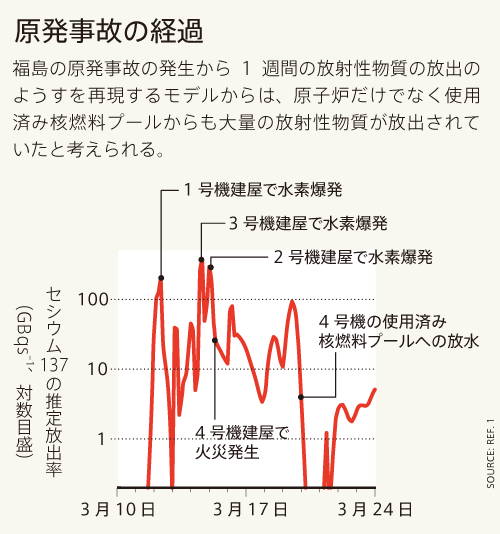
原発事故の経過
原発事故の経過 | 拡大する
さらに、Stohl らは、4号機の使用済み核燃料プールに貯蔵されていた核燃料が、莫大な量のセシウム137を放出していた可能性を指摘している。政府はこれまで、プールからは放射性物質はほとんど漏れ出していないと主張してきた。しかし、研究チームのモデルでは、プールへの放水をきっかけに原発からのセシウム137の放出が激減したことが、はっきり示されている(図「原発事故の経過」参照)。つまり、もっと早い段階から4号機プールへの放水を行っていれば、放射性物質の放出をもっと抑制できたかもしれないのだ。

しかし、政府は、使用済み核燃料プール自体に大きな損傷はなく、使用済み核燃料が重大な汚染源になったとは考えられないと主張している。政府による公式推定値の算出にかかわった日本原子力研究開発機構(茨城県東海村)の茅野政道(ちのまさみち)は、「4号機から放出された放射性物質は多くはなかったと思います」と言う。だが De Geer は、核燃料プールの関与を含めた今回の新しい分析は、「説得力があるように見えます」と語る。

さらに今回の分析は、もう1つ新たなデータを提示している。地震の直後、津波が福島第一原発に襲いかかる前から、キセノン133が漏れ始めていたというのだ。つまり、原発は、津波が襲来する前から、地震によって損傷していたことになる。政府の報告書でも、福島第一原発電を襲った揺れの大きさが、原発設計時に想定されていた揺れを上回っていたことを認めている。反原発の活動家は、以前から、政府が原発を認可する際に地質学的な危険を十分に考慮していないと主張しており(Nature 448, 392-393; 2007)、今回のキセノンの大量放出は、原発の安全性についての評価方法の再考を促すことになるかもしれないと、山内は言う。
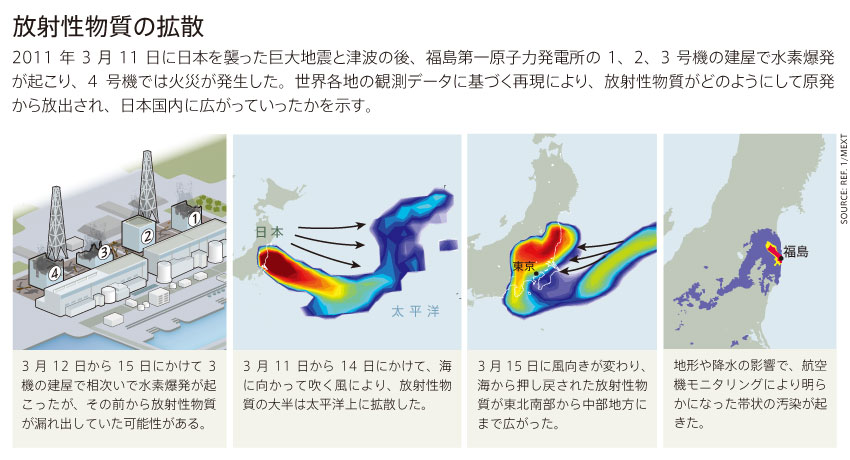
放射性物質の拡散
放射性物質の拡散 | 拡大する
この事故で、首都圏はどうだったのか。実は、原発事故により甚大な被害を受けるおそれがあった。事故直後の数日間は、風は海に向かって吹いていたが、3月14日の午後、風向きが変わって陸に向かって吹き始め、セシウム137が東北南部から中部地方にまで広がっていった(図「放射性物質の拡散」参照)。実際、15日夜から16日未明にかけて雨が降った栃木県と群馬県の山間部では、のちに土壌から比較的高濃度の放射性物質が検出された。一方、首都圏では、そうした高濃度の放射性物質が上空を通過したときに、たまたま雨が降らなかったことが幸いした。「この時期に雨が降っていたら、東京も今よりずっと深刻な事態になっていたかもしれません」と Stohl は言う。(編集部註:ただし、(独)国立環境研究所の空間線量測定とシミュレーションによれば、21日から22日にかけても放射性物質が南関東に流れ込んだことが示されている。このときは、雨が降っていたため、南関東でも一部の地域で比較的高い線量が観測されていると思われる。)
 
(翻訳:三枝小夜子)


参考文献
1.  Stohl, A. et al. Atmos. Chem. Phys. Discuss. 11, 28319-28394 (2011).
2.  Report of Japanese Government to the IAEA Ministerial Conference on Nuclear Safety, "The Accident at TEPCO's Fukushima Nuclear Power Stations"
3.  Chino, M. et al. J. Nucl. Sci. Technol. 48, 1129-1134 (2011).

================================================================

http://www.nature.com/news/2011/111025/full/478435a.html

Published online 25 October 2011 | Nature 478, 435-436 (2011) | doi:10.1038/478435a

News

Fallout forensics hike radiation toll

Global data on Fukushima challenge Japanese estimates.

The Fukushima accident led to mass evacuations from nearby towns such as Minamisoma.The Fukushima accident led to mass evacuations from nearby towns such as Minamisoma.AP Photo/S. Ponomarev

The disaster at the Fukushima Daiichi nuclear plant in March released far more radiation than the Japanese government has claimed. So concludes a study1 that combines radioactivity data from across the globe to estimate the scale and fate of emissions from the shattered plant.
The study also suggests that, contrary to government claims, pools used to store spent nuclear fuel played a significant part in the release of the long-lived environmental contaminant caesium-137, which could have been prevented by prompt action. The analysis has been posted online for open peer review by the journal Atmospheric Chemistry and Physics.
Andreas Stohl, an atmospheric scientist with the Norwegian Institute for Air Research in Kjeller, who led the research, believes that the analysis is the most comprehensive effort yet to understand how much radiation was released from Fukushima Daiichi. "It's a very valuable contribution," says Lars-Erik De Geer, an atmospheric modeller with the Swedish Defense Research Agency in Stockholm, who was not involved with the study.

The reconstruction relies on data from dozens of radiation monitoring stations in Japan and around the world. Many are part of a global network to watch for tests of nuclear weapons that is run by the Comprehensive Nuclear-Test-Ban Treaty Organization in Vienna. The scientists added data from independent stations in Canada, Japan and Europe, and then combined those with large European and American caches of global meteorological data.

Stohl cautions that the resulting model is far from perfect. Measurements were scarce in the immediate aftermath of the Fukushima accident, and some monitoring posts were too contaminated by radioactivity to provide reliable data. More importantly, exactly what happened inside the reactors — a crucial part of understanding what they emitted — remains a mystery that may never be solved. "If you look at the estimates for Chernobyl, you still have a large uncertainty 25 years later," says Stohl.

Nevertheless, the study provides a sweeping view of the accident. "They really took a global view and used all the data available," says De Geer.

Challenging numbers

Japanese investigators had already developed a detailed timeline of events following the 11 March earthquake that precipitated the disaster. Hours after the quake rocked the six reactors at Fukushima Daiichi, the tsunami arrived, knocking out crucial diesel back-up generators designed to cool the reactors in an emergency. Within days, the three reactors operating at the time of the accident overheated and released hydrogen gas, leading to massive explosions. Radioactive fuel recently removed from a fourth reactor was being held in a storage pool at the time of the quake, and on 14 March the pool overheated, possibly sparking fires in the building over the next few days.


But accounting for the radiation that came from the plants has proved much harder than reconstructing this chain of events. The latest report from the Japanese government, published in June, says that the plant released 1.5 × 1016 bequerels of caesium-137, an isotope with a 30-year half-life that is responsible for most of the long-term contamination from the plant2. A far larger amount of xenon-133, 1.1 × 1019 Bq, was released, according to official government estimates.
The new study challenges those numbers. On the basis of its reconstructions, the team claims that the accident released around 1.7 × 1019 Bq of xenon-133, greater than the estimated total radioactive release of 1.4 × 1019 Bq from Chernobyl. The fact that three reactors exploded in the Fukushima accident accounts for the huge xenon tally, says De Geer.

Xenon-133 does not pose serious health risks because it is not absorbed by the body or the environment. Caesium-137 fallout, however, is a much greater concern because it will linger in the environment for decades. The new model shows that Fukushima released 3.5 × 1016 Bq caesium-137, roughly twice the official government figure, and half the release from Chernobyl. The higher number is obviously worrying, says De Geer, although ongoing ground surveys are the only way to truly establish the public-health risk.

Stohl believes that the discrepancy between the team's results and those of the Japanese government can be partly explained by the larger data set used. Japanese estimates rely primarily on data from monitoring posts inside Japan3, which never recorded the large quantities of radioactivity that blew out over the Pacific Ocean, and eventually reached North America and Europe. "Taking account of the radiation that has drifted out to the Pacific is essential for getting a real picture of the size and character of the accident," says Tomoya Yamauchi, a radiation physicist at Kobe University who has been measuring radioisotope contamination in soil around Fukushima.


Stohl adds that he is sympathetic to the Japanese teams responsible for the official estimate. "They wanted to get something out quickly," he says. The differences between the two studies may seem large, notes Yukio Hayakawa, a volcanologist at Gunma University who has also modelled the accident, but uncertainties in the models mean that the estimates are actually quite similar.
The new analysis also claims that the spent fuel being stored in the unit 4 pool emitted copious quantities of caesium-137. Japanese officials have maintained that virtually no radioactivity leaked from the pool. Yet Stohl's model clearly shows that dousing the pool with water caused the plant's caesium-137 emissions to drop markedly (see 'Radiation crisis'). The finding implies that much of the fallout could have been prevented by flooding the pool earlier.
The Japanese authorities continue to maintain that the spent fuel was not a significant source of contamination, because the pool itself did not seem to suffer major damage. "I think the release from unit 4 is not important," says Masamichi Chino, a scientist with the Japanese Atomic Energy Authority in Ibaraki, who helped to develop the Japanese official estimate. But De Geer says the new analysis implicating the fuel pool "looks convincing".
The latest analysis also presents evidence that xenon-133 began to vent from Fukushima Daiichi immediately after the quake, and before the tsunami swamped the area. This implies that even without the devastating flood, the earthquake alone was sufficient to cause damage at the plant.

ADVERTISEMENT

The Japanese government's report has already acknowledged that the shaking at Fukushima Daiichi exceeded the plant's design specifications. Anti-nuclear activists have long been concerned that the government has failed to adequately address geological hazards when licensing nuclear plants (see Nature 448, 392–393; 2007), and the whiff of xenon could prompt a major rethink of reactor safety assessments, says Yamauchi.
The model also shows that the accident could easily have had a much more devastating impact on the people of Tokyo. In the first days after the accident the wind was blowing out to sea, but on the afternoon of 14 March it turned back towards shore, bringing clouds of radioactive caesium-137 over a huge swathe of the country (see 'Radioisotope reconstruction'). Where precipitation fell, along the country's central mountain ranges and to the northwest of the plant, higher levels of radioactivity were later recorded in the soil; thankfully, the capital and other densely populated areas had dry weather. "There was a period when quite a high concentration went over Tokyo, but it didn't rain," says Stohl. "It could have been much worse." 
Additional reporting by David Cyranoski and Rina Nozawa.