2013年10月14日月曜日

Nuclear Mafia Derails Democracy in Japan


http://www.counterpunch.org/2012/09/04/nuclear-mafia-derails-democracy-in-japan/

Exclusively in the new print issue of CounterPunch

KILLING DETROIT — Darwin Bond-Graham on the planned destruction of America’s greatest industrial city; AMERICAN AMAZON: Susanna Hecht on the surreal history of American attempts to turn the Amazon into a colony for slavers and speculators; FOCUSING HIROSHIMA: Jeffrey St. Clair interviews artist elin o’Hara slavick on her startling new project photographing radioactive objects from the Hiroshima bombing; HUMAN RIGHTS, COPY WRONGS: Lee Ballinger on the perversities of intellectual property rights. PLUS: Empire of the Senseless by Jeffrey St. Clair; Gramsci in the Bronx by JoAnn Wypijewski; Obama’s Shock Doctrine by Mike Whitney; Pious Virtuosos of Violence by Chris Floyd; and War Chests by Kristin Kolb.

September 04, 2012

A Deteriorating Situation

Nuclear Mafia Derails Democracy in Japan

by RICHARD WILCOX

“End of the day, factory whistle cries, Men walk through these gates with death in their eyes” – Bruce Springsteen, Factory (1)
“Bring us the living dead. People no one will miss.” – Fukushima official’s request to Yakuza (2)
“TEPCO’s involvement with anti-social forces and their inability to filter them out of the work-place is a national security issue … Nuclear energy shouldn’t be in the hands of the yakuza. They’re gamblers and an intelligent person doesn’t want them to have atomic dice to play with.” – Japanese Senator (3)
The technological issue of nuclear energy is intertwined with the exploitation of human labor in a hierarchy of interests, and how human labor is expended is an economic and moral issue. The Grand Scientific Project from the time of Francis Bacon up to the Manhattan Project of Oppenheimer and Fermi has been a dangerous gamble for humanity even though the advertised purpose is that progress is good.
The exploitation of labor at nuclear plants depends on the tools of social engineering, of government, mass media and schools. This is the hidden and shameful side of today’s materialist society and belies our complicity in a criminalized culture.
Inefficient and corrupt employment practices at the Fukushima Nuclear Power Plant (FNPP) are prolonging the disaster. Tokyo Electric Power Company (Tepco) outsources 90 percent of the work to subcontractors, mainly utilizing Japan’s criminal syndicates, “the Yakuza.” Japan is still a middle class society and most people will not volunteer for nuclear work. Japan risks running out of workers who have not exceeded their legal radiation limits.
Considered to be “Japan’s largest organized crime group” — who are on the radar of the US Treasury Dept. (another big crime group) (4) — the Yakuza offer a service to society by sopping up its losers and giving them a dodgy occupation.
Journalist, Jake Adelstein, an expert on the Yakuza, risked his life as a reporter on the crime beat in Japan. Not because of shoot outs or knife fights, but because he had to take up smoking cigarettes in order to fit in with police and yakuza! These short video interviews offer a useful introduction into how the Yakuza operate (5; 6). Tepco’s relationship with the Yakuza is a cesspool of corruption from the highest to the lowest levels in its organization. “A senior National Police Agency officer, speaking on grounds of anonymity said, ‘TEPCO has a history of doing business with the yakuza that is far deeper than just using their labor’ ” (Op. cit. “The Yakuza and the Nuclear Mafia”).
Adelstein notes that the Yakuza has 86,000 members in Japan, of the 22 major organizations the “Yamaguchi” has almost half of all members. The Yakuza are:“[c]riminal trade associations legally recognized by the Japanese government … They exist out in the open. The Japanese government regulates them and there are laws restricting their behavior but as criminal organizations themselves they are not banned. It is very difficult for the police to do an investigation that goes all the way up to the top. It’s problems within the Japanese law itself. There’s no plea bargaining, very limited wire tapping, no witness protection program … no undercover work allowed. The Japanese police are never able to destroy the Yakuza” (Op. cit. interviews).
“[T]he nuclear business-industrial-political and media complex in Japan known as the ‘nuclear mafia’ … [the nuclear industry] is a black hole of criminal malfeasance, incompetence, and corruption’ …. The government tacitly recognises their existence, and they are classified, designated and regulated. Yakuza make their money from extortion, blackmail, construction, real estate, collection services, financial market manipulation, protection rackets, fraud and a labyrinth of front companies including labour dispatch services and private detective agencies. They do the work that no one else will do or find the workers for jobs no one wants …. The Fukushima plant is located in the turf of the Sumiyoshi-kai, which is the second largest yakuza group in Japan with roughly 12,000 members” (Op. cit. “How the Yakuza went Nuclear”; “The Yakuza”).
Without the dregs of society to do the dirty work, modern society could not exist its present, most hypocritical form. Most people do not want to get dirt under their fingernails and prefer to apply nail polish or chat on their iPhones.
Working in nuclear power plants in Japan is not considered an honorable and elegant trade, like cabinet making or industrial design, but a brutal, labor intensive experience. While the Yakuza organization itself is an evil, the workers themselves can be considered heroes. The amount of excruciating heat, hard work, physical and mental stress and radiation they endure is inhuman. Even working at a normally functioning reactor is not easy or safe work but the FNPP is highly radioactive.
Fearless Reporter Tells All
Adelstein reviews an astounding new book, “The Yakuza and the Nuclear Industry,” by undercover Japanese reporter, Tomohiko Suzuki (Op. cit. “The Yakuza”). Suzuki truly risked his life, due to radiation exposure and possible threats, to bring us the details from the Nuclear Hell Zone. The book reveals scandalous information such as that mentally handicapped people are recruited to work in the nuke plants by the Yakuza. Suzuki compares the Yakuza with Tepco: “Yakuza may be a plague on society … but they don’t ruin the lives of hundreds of thousands of people and irradiate the planet out of sheer greed and incompetence.”
Having lived in Tokyo for many years, I concur. I am not a fan of Yakuza culture and can see in my daily experience that the Yakuza have a degrading effect on society. But as long as you don’t mess with them– they won’t mess with you. In this way, the streets of Tokyo remain fairly safe.
Suzuki points out that “Japan’s nuclear mafia … [is a] conglomeration of corrupt politicians and bureaucrats, the shady nuclear industry, their lobbyists” with the Yakuza at the center. Is Suzuki implying that the Yakuza run the Nuclear Mafia? It is certainly true that Tepco could not fulfill a nuclear workforce without them. According to Adelstein:
“As the scale of the catastrophe at Fukushima became apparent, many workers fled the scene. To contain the nuclear meltdown, a handful of workers stayed behind, being exposed to large amounts of radiation: the so-called ‘Fukushima Fifty.’ Among this heroic group, according to Suzuki, were several members of the yakuza …. ‘Almost all nuclear power plants that are built in Japan are built taking the risk that the workers may well be exposed to large amounts of radiation …. That they will get sick, they will die early, or they will die on the job. And the people bringing the workers to the plants and also doing the construction are often yakuza’ (Op. cit. “How the Yakuza”).
The very workers who are attempting to shore up the situation at FNPP, many of whom are Yakuza, are being blamed by local people in Fukushima for the disaster. A recent survey reported that 30 percent of 1,495 workers at the site suffer from severe mental health issues. The survey does not even include the most exploited workers at the site (7).
Nuclear Situation Deteriorating
Akio Matsumura is a renowned Japanese diplomat and “founder and Secretary General of the Global Forum of Spiritual and Parliamentary Leaders on Human Survival.” He sounds like the right man for the job to tackle the Fukushima nuclear disaster. Unfortunately, his warnings are falling on deaf ears. In a recent column he reported that the “Skilled Veterans Corps for Fukushima, along with 700 members, want to help clean up” the FNPP. Most of the volunteers are in their older years so getting cancer is not as great of a threat, whereas younger workers could die prematurely. The group’s representative, Mr. Yamada, “doesn’t believe TEPCO has the technological capabilities to deal with the long term issues. TEPCO, he says, doesn’t believe this either. TEPCO’s plan, according to Yamada, is to contain the radiation in the next 40 years. He estimates they will need 50 years or perhaps much longer.”
Matsumura thinks more aggressive actions won’t be taken: “Regrettably I do not expect much of an outcome. After 17 months, the situation is worsening and unless Japan requests the independent assessment team and guarantees a huge budget to carry out the team’s technical advice, the US government will not step in” to help (8).
US nuclear policy is equally dangerous, thus, a safe and speedy resolution to what appears to be an insurmountable problem is not on the horizon. Tony Boys worked as an interpreter for nuclear expert, Dr. Chris Busby, on his visit to Japan last year. Boys told me“They may be ‘rebuilding’ at the FNPP, but I don’t think that solves the fundamental problem. You know how the Japanese love to do something cosmetic to make things look good because they don’t know how to really do it properly, but have to do ‘something’ ? Well, I think that’s largely what is going on at the site.”
Radio host, Jeff Rense, whose website has studiously reported on the nuclear catastrophe and all of Japan’s botched policies, told me that “everything they do is horrendous.” For example, Japan’s decision to ship contaminated Fukushima soil all the way across the country is truly stupefying (9).
Prime Minister Noda recently rejected protester’s requests to shut down the nuclear reactors. As the Metropolitan Coalition Against Nukes told Noda in a face to face meeting, “[w]e the people do not believe you” regarding his empty promises to phase out nukes in the future. The Nuclear Mafia are restarting reactors even though they are unnecessary for electricity production. An overwhelming majority of people want to abolish nuclear power (10; 11; 12). Having contaminated the world with quadrillions of becquerels of radiation (petabecquerels), Tepco is under a pseudo nationalization process that funnels tax money into their pockets yet maintains their autonomy (13).
Worker Shortage
A common practice among workers in nuclear plants is to hide their real exposure rate of radiation. Because there are legal limits of radiation exposure, workers will take off their dosimeters, or cover them with lead. In normal times in Japan workers could also migrate from one plant to the other without indicating previous work experience, and work “under the table.” How long it takes to get sick and or die from such a practice is anyone’s guess.
If the “living dead,” the people “no one will miss” and the dregs of society can’t be coerced into sacrificing themselves, how about top Tepco executives or pro nuclear professors from Tokyo University for a helping hand? Good idea! But first you will have to chase them down on the golf course. NHK reports that:“[M]any workers crucial to the effort are reaching the limit for radiation exposure …. University of Tokyo Professor Kazumitsu Nawata warns of the consequences of losing nuclear plant workers with necessary expertise. He says young workers must be trained due to the need for massive manpower to fully bring the Daiichi plant under control.”
Is Professor Nawata volunteering other’s children for this dirty job, or maybe his own children would prefer to work in the High Sievert Zone? Tokyo University bears a heavy responsibility for the current catastrophe for its role in legitimizing the Nuclear Mafia.
A notable percentage of workers are leaving once they have reached the legal radiation limits. Of the 3,000 daily workers, “[s]ome of the firms have adopted stricter exposure standards … so that they do not breach the limit and become unemployable” (14).
A number of recent incidents have highlighted the scandal over worker safety, including:
* Over 140 workers have been found to have used fake names when getting jobs doing reconstruction work and are presently unaccounted for (Op. cit., “The Yakuza”).
* Workers have purposely left integral dosimeter off their person while at work. “Tepco is pushing the responsibility to their sub-contract companies but has no solution for the shortage of nuclear workers” which indicates “major staffing problems” at the plant (15; 16).
* Some workers themselves think the only solution to shoring up the plant will be “human wave tactics” as were employed at Chernobyl (17). If that is the case, where will the necessary workforce come from? In order combat the dwindling labor force, Tepco and subcontractors are knowingly telling workers to fake their radiation data. The practice is “believed to be part of a widespread practice at the plant” (18; 19; 20).
Former General Electric nuclear plant inspector, a whistle blower who previously exposed dangers at the Fukushima plant–that were ignored–Kei Sugaoka, admitted that he had heard of young workers in the Taiwan nuclear industry dying from cancer due to radiation. When he worked in Taiwan he says “[t]hey made us wear lead vests to falsify radiation exposure … All the lead did was cover our dosimeters” (21).
Despite the need to quickly resolve the situation, workers are given weekends off, but are also being recruited for decontamination in the 20 km zone. Speculation is that restart of other reactors in Japan will worsen the worker shortage. Japan seems to be going in too many directions at once (22; 23; 24).
The Nuclear Workforce
French sociologist, Paul Jobin, “began research on Japanese and Taiwanese nuclear plant workers in 2002, mainly at Fukushima Daiichi,” and he did follow up interviews after the Fukushima disaster in 2011.
Jobin notes that:
* Subcontracting labor at nuclear plants in Japan began shortly after their creation, in the mid-1970s. “In France, this trend would develop after 1988, reaching a rate of 80% by 1992.”
* “According to NISA’s data, in 2009, Japan’s nuclear industry recruited more than 80,000 contract workers against 10,000 regular employees.”
* Part time employment is carried out in order to limit labor costs “whether in France or Japan, the nuclear industry nurtures a heavy culture of secrecy concerning the number of irradiated workers.”
* Before the Fukushima disaster, “only 9 former workers received compensation for an occupational cancer linked to their intervention in nuclear plants.” This number is probably far lower than the real number of those who suffered from working at NPPs.
* “[S]tatistics from TEPCO (dated November 30, 2011) reported 3,745 workers on the site in March (about 1700 TEPCO employees and 2,000 subcontractors), and 14,000 for the time from April to October. The overwhelming majority … were subcontractors.” But even these figures may not include many low level but highly irradiated workers.
* Radiation exposure depends on one’s status in the hierarchy. Tepco executives and high or mid level engineers are spared exposure, while “there is systematic camouflage of the collective radiation of the most exposed front line workers.”
* Since March 11, 2011, Jobin estimates “that around 30,000 workers have been exposed to significant levels of radiation, some for a few days, many for more than one month” (25; 26). How many of these workers are desperate or “mentally handicapped” to begin with? No wonder they are being used by the Nuclear Mafia as disposable work-bots. Hiroaki Koide, nuclear reactor specialist at Kyoto University says “[t]he truth of the matter is that the subcontract workers don’t really know the dangers of radiation and they don’t know how to protect themselves.” For example, wearing protective masks are so uncomfortable that many workers remove them during their work shift (27). How many health issues have been caused as a direct result of the work? In one case, the worker had been exposed in less than a year to levels far beyond what is considered normal lifetime background radiation. He suffered a heart attack (28).
Worker Rights Advocates Fight For Social Justice
Hifumi Okunuki is an expert in labor law and spends much of her time fighting for the rights of Fukushima’s forgotten heroes. She notes that “the working conditions at Fukushima No. 1 are an emergency within an emergency” and that “special laws should be promulgated to guarantee the safety and fair treatment of the workers.”
“Japan’s Labor Standards Office has thus far recognized only 10 cases of radiation sickness caused by working conditions due to the inherent difficulty in proving causation in individual cases …. Management faces quite serious, possibly criminal, liability if while understanding the risk radiation exposure poses, they endanger those working on-site through a complicated web of outsourcing. Article 87 of the Labor Standards Law holds firms that outsource responsible for workplace safety and sanitation for workers employed by their subcontractor …. Illnesses caused by radiation exposure from nuclear power plants are covered by Japan’s Act on Compensation for Nuclear Damage.”
Unsurprisingly, the Japanese justice system which plays an integral role in siding with the Nuclear Mafia has “yet to see a major court case over radiation-related deaths” (29).
A new report from the venerable non governmental organization, Citizens Nuclear Information Center (CNIC), in Tokyo, highlights the FNPP worker issue. One whistle blower reported that in years past:
“Worker accidents are usually covered up inside the nuclear plant. Even if workers suddenly fall ill, they are not allowed to call an ambulance. In my case, after having been left unattended for three hours, I was taken to hospital in a colleague’s car. I therefore suffered aftereffects later and became physically handicapped. Of all accidents occurring in the nuclear power station, 90% were concealed.”
However, thanks to growing international attention, some of the conditions at FNPP have slightly improved. “Currently, ambulances are allowed to come into the nuclear power station and there is a doctor onsite 24 hrs a day“ (30).
Tepco’s Blind Eye
According to CNIC (Ibid.), the system for employing nuclear workers relies on an economically pyramid shaped, “multi-layered structure” of contractors and subcontractors which makes profits for executives and employees. Investigations have revealed the “[p]resence of subcontractors affiliated with crime syndicates and their employees.” In the year 2000 it was known that “350 companies were involved” at the FNPP and that many of the Yakuza employees or subcontractors are presently involved in the clean up operations.* “Under the utility, there are plant makers, subsidiaries of TEPCO and the plant makers, large, medium- and small-sized construction and repair companies, independent master carpenters and plumbers.”
* The Yakuza enforce a severe hierarchy “between the group leader and the members” which is akin to the military and effective for getting dangerous work accomplished.
* “[I]n 2006, TEPCO reportedly attempted to drive the gangsters … out of the plant.” The Yakuza said: “Do it if you think you can.” Tepco blinked.
* ‘[P]olice arrested leading members of a gangster group affiliated with the Sumiyoshi-kai crime syndicate based in Nihonmatsu, Fukushima Prefecture’ who were ‘charged with violation of the Temporary Staffing Services Law.’ A president of a local company who ‘was deeply involved in the staffing of the nuclear power station and was the president of the local chamber of commerce and industry, as well as a member of the Fukushima Prefecture Nuclear Power Plant Town Information Council’ was arrested on suspicion of ‘illegally possessing a gun.’
* “Workers hired by the lowest-level subcontractors were paid only around 5,000 yen [$60] per day, and were not covered by social insurance or employment insurance …. the current average daily wage is said to be 8,000 yen, although TEPCO pays 60,000-70,000 yen per capita to the principal subcontractor.” Everyone in between ‘takes a cut from the worker’s wages.’
In other words, it’s an economic racket. Although an “effective” system, “[i]llegal acts, such as the forgery of health reports … and not allowing workers to subscribe to health insurance and employees’ pension plans, are rampant,” but are tolerated by Tepco. This draws into question how effective such workers can be given the intimidation of violence from Yakuza bosses and the poor working conditions. The “problem is still beyond TEPCO’s control because the subcontractor system is deeply multi-layered and complex, and because the yakuza are so deeply entrenched in the system.”
Destroying Democracy
The 1995 documentary film, Nuclear Ginza, is valuable for its historical perspective on nuclear workers in Japan (31). Corruption, payoffs and coverups were the norm, then and now. As one worker whose health was damaged said,
“The big companies treat workers like objects or tools to be thrown away when no longer needed. Japan is considered a rich advanced and democratic country but its just an illusion I think.”
A Buddhist monk, Mr. Nakajima, who had worked for years to help the plight of workers noted that “[u]nfortunately in Japan, the sad reality is that democracy has been destroyed in the areas where nuclear power exists.”
Streets of Fire
Adelstein and Suzuki (Op. cit.) supply additional information of a particularly lurid and grim nature:
* Yakuza have a saying: “When a man has to survive doing something, it’s the nuclear industry; for a woman, it’s the sex industry.”
* One mid-level executive in the organization even defends the role of his members in the Fukushima disaster. “The accident isn’t our fault,” he said. “It’s TEPCO’s fault. We’ve always been a necessary evil in the work process. In fact, if some of our men hadn’t stayed to fight the meltdown, the situation would have been much worse. TEPCO employees and the Nuclear Industry Safety Agency inspectors mostly fled; we stood our ground.”
* “Organized crime groups from Kyushu are bringing workers as well. Many of the workers are homeless people, debtors to yakuza loan sharks, or former yakuza who have been expelled from their group.”
* Tepco refuses “to name the companies they use for outsourcing labor, background security checks, and general security at the nuclear power plants.” Recall Tepco’s feigned ignorance about government investigator’s accusations against them for “collusion.” Such bland dismissals on the part of Tepco are curious in light of the voluminous evidence to the contrary. The Tepco president’s denials of any collusion is an obvious lie (32; 33).
* “Suzuki discovered evidence of Tepco subcontractors paying yakuza front companies to obtain lucrative construction contracts; of money destined for construction work flying into yakuza accounts; and of politicians and media being paid to look the other way.”
* “His fellow workers, found Suzuki, were a motley crew of homeless, chronically unemployed Japanese men, former yakuza, debtors who owed money to the yakuza, and the mentally handicapped.”
* “Suzuki claims the regular employees at the plant were often given better radiation suits than the yakuza recruits. ‘Almost every day a worker would keel over with heat exhaustion and be carried out; they would invariably return to work the next day. Going to the bathroom was virtually impossible, so workers were simply told to ‘hold it.’ ’ ”
* “According to Suzuki, the temperature monitors in the plant weren’t even working, and were ignored. Removing the mask during work was against the rules; no matter how thirsty workers became, they could not drink water.”
* “The risk of radiation exposure was 100 per cent. The masks, if their filters were cleaned regularly, which they were not, could only remove 60 per cent of the radioactive particles in the air.”
* “Suzuki found people who’d been threatened into working at Fukushima, but others who’d volunteered. Why? ‘Of course, if it was a matter of dying today or tomorrow they wouldn’t work there,’ he explains. ‘It’s because it could take 10 years or more for someone to possibly die of radiation excess. It’s like Russian roulette. If you owe enough money to the yakuza, working at a nuclear plant is a safer bet. Wouldn’t you rather take a chance at dying 10 years later than being stabbed to death now?’ ”
Conclusion
Faced with an ongoing radioactive nightmare which is contaminating Japan’s food and water supply, what should be done? The Nuclear Mafia’s ethos is silken sewn into the socio-political Kabuki theater of a post modern Japanese society, which seems helpless to save itself. Maybe Ambassador Matsumura, with his international political connections of good will, and the Skilled Veterans for Fukushima would be good people to turn to for advice.
Richard Wilcox is a writer living in Tokyo.
References
1. Factory
http://www.springsteenlyrics.com/lyrics/f/factory.php
2. How the Yakuza went nuclear http://www.telegraph.co.uk/news/worldnews/asia/japan/japan-earthquake-and-tsunami-in/9084151/How-the-Yakuza-went-nuclear.html
3. The Yakuza and the Nuclear Mafia
http://www.theatlanticwire.com/global/2011/12/yakuza-and-nuclear-mafia-nationalization-looms-tepco/46803/
4. U.S. Treasury Dept. Penalizes Japan’s Largest Organized-Crime Group
http://www.nytimes.com/2012/02/25/world/asia/united-states-sanctions-japans-largest-organized-crime-group-yakuza.html
5. Jake Adelstein
http://wheelercentre.com/videos/video/jake-adelstein/
6. Jake Adelstein on Tokyo’s yakuza
http://www.youtube.com/watch?v=d0uz0z_NH4U
7. No. 1 workers’ stress, stigma jeopardizing motivation
http://www.japantimes.co.jp/text/nn20120816a5.html
8. Fukushima Needs a Hero
http://akiomatsumura.com/2012/08/862.html
9. Kagoshima to be the final disposal site of nuclear waste
http://fukushima-diary.com/2012/08/kagoshima-to-be-the-final-disposal-site-of-nuclear-waste/
10. Noda unswayed by talks with rally leaders
http://www.japantimes.co.jp/text/nn20120823a1.html
11. Power use falls; reactors unneeded
http://www.japantimes.co.jp/text/nn20120822a3.html
12. Antinuclear Japan: Nearly 90% of Public Comments on National Energy Policy Are “Zero Nuke”
http://ex-skf.blogspot.jp/2012/08/antinuclear-japan-nearly-90-of-public.html
13. Mismanaging Risk and the Fukushima Nuclear Crisis
http://www.japanfocus.org/-Jeff-Kingston/3724
14. Fukushima nuclear workers reaching exposure limit
http://www3.nhk.or.jp/daily/english/20120824_29.html
15. Worker left integral dosimeter in the bus on purpose
http://fukushima-diary.com/2012/08/nuke-worker-shortage-worker-left-integral-dosimeter-in-the-bus-on-purpose/
16. WSJ: Experts say manipulated radiation readings http://blogs.wsj.com/japanrealtime/2012/07/23/fukushima-watch-doctoring-dosimeters-how-far-did-it-go/
17. Fukushima worker “Human-wave tactics will be needed, problem is if they can collect human workers”
http://fukushima-diary.com/2012/07/fukushima-worker-human-wave-tactics-will-be-needed-problem-is-if-they-can-collect-human-workers/
18. Tepco knew lead shields were made to cover dosimeters of Fukushima workers
http://enenews.com/tepco-knew-lead-shields-were-being-made-to-cover-dosimeters-of-fukushima-workers-boss-admits-to-making-them-use-covers-claims-he-was-frightened-of-radiation-alarms
19. TEPCO subcontractor used lead to fake dosimeter readings at Fukushima plant
http://ajw.asahi.com/article/0311disaster/fukushima/AJ201207210069
20. ‘Growing concern’ over worker shortages at Fukushima Daiichi by gov’t http://online.wsj.com/article/SB10000872396390443570904577542400362861824.html
21. Nuclear Worker: There’s been some people dying, young guys, of some weird cancers
http://enenews.com/nuclear-worker-young-people-dying
22. Worker confirms Tepco taking weekends off at Fukushima Daiichi
http://enenews.com/tepco-weekends-fukushima-daiichi-plant-worker
23. Recruit for decontamination worker in 20km area
http://fukushima-diary.com/2012/07/recruit-for-decontamination-worker-in-20km-area/
24. Fukushima worker “Restart of nuclear plants will cause shortage of Fukushima workers”
http://fukushima-diary.com/2012/07/fukushima-worker-restart-of-nuclear-plants-will-cause-shortage-of-fukushima-workers/
25. Dying for TEPCO? Fukushima’s Nuclear Contract Workers
http://www.globalresearch.ca/PrintArticle.php?articleId=24543
26. Fukushima One Year On: Nuclear workers and citizens at risk
http://www.japanfocus.org/-Paul-Jobin/3729
27. Japan Nuclear Professor – Atomic Age Symposium II
http://enenews.com/japan-nuclear-professor-radiation-released-smoke-stacks-fukushima-plant-daily-basis-video
28. Fukushima Plant Worker Suffers Cardiac Arrest
http://jen.jiji.com/jc/eng?g=eco&k=2012082200902
29. Tepco liable for contract workers’ safety in Fukushima
http://www.japantimes.co.jp/text/fl20120821lp.html?utm_source=feedburner&utm_medium=feed&utm_campaign=Feed%253A+japantimes+%2528The+Japan+Times%253A+All+Stories%2529
30. Clean-up operation at the nuclear accident site at Fukushima Daiichi Nuclear Power Station.
http://www.cnic.jp/english/newsletter/nit149/nit149articles/05_Clean-up.html
31. Nuclear Ginza – Part 1
http://www.youtube.com/watch?v=CNq0qyQJ5xs
Part 2
http://www.youtube.com/watch?v=t7okfjwy4Vw&feature=relmfu
32. Radioactive Rats, Nuclear Techno Geeks
And Life In The Damage Control Continuum
http://rense.com/general95/radioactive-rats.html
33. Japan’s Tepco baffled by criticism of its role in nuclear disaster
http://www.reuters.com/article/2012/07/19/japan-nuclear-tepco-idUSL4E8IJ1S020120719

Counterpunch

2013年10月12日土曜日

Caution Abe:Radioactive waste equivalency product :放射性廃棄物相当品


The warning that is biggest in history of human

Abe:Radioactive waste equivalency product


Crazy Abe:Radioactive waste equivalency product


Nuclear Waste Disposal Documentary

Nuclear Waste Disposal Documentary  


公開日: 2013/06/02
A new documentary that examines the nuclear waste disposal problem in just one location. We have these sites across the globe, all over our oceans. There are even instances where pipes have been setup in the sea, so the waste can be disposed off even easier and unseen.

===================================================================

Into Eternity- radioactive Waste-  


公開日: 2013/04/27
Copyright Disclaimer, Under Section 107 of the Copyright Act 1976, allowance is made for 'fair use' for purposes such as criticism, comment, news reporting, teaching, scholarship, and research. Fair use is a use permitted by copyright statute that might otherwise be infringing. Non-profit, educational or personal use tips the balance in favor of fair use.

===================================================================

The Place You Must Always Remember to Forget - Nuclear Waste


公開日: 2012/09/15
Documentary on Underground Storage of Nuclear Waste.
Outlines the pros and cons of this method of storage for the tons of waste
produced by the Nuclear Power Industry. Interesting the most difficult threat to
mitigate is the human one.....*sigh. Great Footage, Creative Commons Universal 1.0
Shows building of repository and internal workings at plant.
Spooky Film! When and if we stop nuclear power we are going to need a lot of repositories like Onkalo, (Hiding Place) Perfect name but imperfect solution.
The guy from the Finish Nuclear Authority reminds me of Dr. Strangelove! (50:40)

===================================================================


===================================================================

US nuclear waste dilemma  


公開日: 2013/02/26
With two decades to go before it can reprocess spent nuclear fuel, the US will have to bury nearly 70,000 tons of it, a research lab reports. It comes after Congress and the Obama administration defunded a planned nuclear waste repository in 2011.

The Oak Ridge National Laboratory, a facility that does research for the Department of Energy (DOE), said that "about 68,450 [metric tons] or about 98 percent of the total current inventory by mass, can proceed to permanent disposal without the need to ensure retrievability for reuse or research purposes" in its report, published near the end of 2012. The rest of the waste, the report said, could be kept available for research on fuel reprocessing and storage.

The report was fairly obscure until being cited in a DOE document that showed plans to find a new permanent waste dump after Congress and the Obama administration cut funding for the Yucca Mountain repository in 2011.

Reprocessing has little support in Washington due to concerns that spent fuel could fall into the wrong hands. Nevertheless the DOE started looking into reprocessing methods in 2005.

But following the March 2011 disaster at Japan's Fukushima Daiichi nuclear power plant, US officials became wary of recycling radioactive waste.

The Blue Ribbon Commission on America's Nuclear Future, co-chaired by Energy Secretary Steven Chu, said that "no currently available or reasonably foreseeable reactor and fuel cycle technology developments - including advances in reprocessing and recycling technologies - have the potential to fundamentally alter the waste management challenges the nation confronts over at least the next several decades, if not longer" in a report.

Watch this video on our website: http://www.presstv.ir/Program/290903....
Broadcast Date: 25 Feb. 2013

Follow our Facebook on: http://www.facebook.com/presstvchannel
Follow our Twitter on: http://twitter.com/presstv
Follow our Tumblr on: http://presstvchannel.tumblr.com

===================================================================

Radiation: How Bad is the Pacific Ocean from Fukushima?

Radiation: How Bad is the Pacific Ocean from Fukushima? (What they


公開日: 2013/07/10
Cesium, iodine and tritium in NW Pacific waters -- a comparison of the Fukushima impact with global fallout
http://tinyurl.com/bnfwcnr
http://www.biogeosciences-discuss.net...

Impacts of the Fukushima nuclear power plant discharges on the ocean
(MULTIPLE studies found here)
http://www.biogeosciences-discuss.net...
http://tinyurl.com/k925vhs
THE 20 STUDIES IN LINK ABOVE INCLUDE:
1~ Inverse estimation of source parameters of oceanic radioactivity dispersion models associated with the Fukushima accident
2~ Surface pathway of radioactive plume of TEPCO Fukushima NPP1 released 134Cs and 137Cs
3~ Determination of plutonium isotopes in marine sediments off the Fukushima coast following the Fukushima Dai-ichi Nuclear Power Plant accident
4~ Iodine-129 concentration in seawater near Fukushima before and after the accident at the Fukushima Daiichi Nuclear Power Plant
5~ Short-term dispersal of Fukushima-derived radionuclides off Japan: modeling efforts and model-data intercomparison
6~ Initial Spread of 137Cs over the shelf of Japan: a study using the high-resolution global-coastal nesting ocean model
7~ Direct observation of 134Cs and 137Cs in surface seawater in the western and central North Pacific after the Fukushima Dai-ichi nuclear power plant accident
8~ 90Sr and 89Sr in seawater off Japan as a consequence of the Fukushima Dai-ichi nuclear accident
9~ Fukushima-derived radiocesium in western North Pacific sediment traps
10~ Natural and Fukushima-derived radioactivity in macroalgae and mussels along the Japanese shoreline
11~ Export of 134Cs and 137Cs in the Fukushima river systems at heavy rains by Typhoon Roke in September 2011
12~ Continuing 137Cs release to the sea from the Fukushima Dai-ichi Nuclear Power Plant through 2012
13~ The impact of oceanic circulation and phase transfer on the dispersion of radionuclides released from the Fukushima Dai-ichi Nuclear Power Plant
14~ Does the Fukushima NPP disaster affect the caesium activity of North Atlantic Ocean fish?
15~ Spatiotemporal distributions of Fukushima-derived radionuclides in surface sediments in the waters off Miyagi, Fukushima, and Ibaraki Prefectures, Japan
16~ Distribution of the Fukushima-derived radionuclides in seawater in the Pacific off the coast of Miyagi, Fukushima, and Ibaraki Prefectures, Japan
17~ Cesium-134 and 137 activities in the central North Pacific Ocean after the Fukushima Dai-ichi nuclear power plant accident
18~ Horizontal distribution of Fukushima-derived radiocesium in zooplankton in the northwestern Pacific Ocean
19~ One-year, regional-scale simulation of 137Cs radioactivity in the ocean following the Fukushima Daiichi Nuclear Power Plant accident
20~ Cesium, iodine and tritium in NW Pacific waters -- a comparison of the Fukushima impact with global fallout

WSJ: Soaring radioactivity levels on coast of Fukushima plant — Nuclear material may have leeched from melted fuel cores and into environment:
http://tinyurl.com/n8vj52o

Wall Street Journal, July 8, 2013: Fukushima Watch: Tritium Levels Soar on Coast at Fukushima Plant [...] More than two years after the devastating accident at Japan's Fukushima Daiichi nuclear plant, operator [Tepco] is seeing levels soar of a radioactive element called tritium. The problem spot is on the coastal side of the plant's heavily damaged No. 2 reactor, one of the areas where Tepco regularly monitors groundwater to check for radioactive elements that may have leeched from the plant's partly melted fuel cores and into the environment. [...]
http://tinyurl.com/lrb26kp

Jiji Press, July 8, 2013: Tokyo Electric Power Co. says 2,300 becquerels per liter of tritium was found in seawater sampled off its crippled Fukushima No. 1 nuclear power station Wednesday, the highest level recorded since the March 2011 accident. [...] It is feared that groundwater containing high levels of tritium may be leaking into the sea from the plant's No. 2 reactor building.
http://tinyurl.com/knwwmzt

Officials report "troubling discovery" at Fukushima nuclear plant: Cesium levels rocket 9,000% over 3 days in groundwater — TEPCO "can't explain it"
http://tinyurl.com/lb2uxks

NHK World
http://tinyurl.com/lb2uxks

Asahi Shimbun:
http://tinyurl.com/khzxcuf

AFP: Toxic radioactive substances in groundwater at Japan's crippled Fukushima nuclear plan have rocketed over the past three days,
http://tinyurl.com/kvp9naqt

Wall Street Journal: Cesium tends to bind with dirt, so it's less likely it would seep distances along with groundwater. [...]
http://tinyurl.com/kh5wqdv

Uncovering Plume-Gate: http://plumegate.wordpress.com/

hatrickpenryunbound: http://hatrickpenryunbound.com/

IMPORTANT:
Plume-Gate PROOF Cover-up of Fukushima via the NRC Documents Playlist (35 videos 26 hours)
http://tinyurl.com/luvc5dx

original upload here: (thank you HatrickPenry) Good Job!
http://youtu.be/P9SilFcYVg4

PLEASE FEEL FREE TO REUPLOAD TO YOUR CHANNEL. NO NEED TO ASK PERMISSION.

===================================================================

FUKUSHIMA UPDATE - CRN SPECIAL REPORT AUG


公開日: 2013/08/22
Alexander Backman's FUKUSHIMA UPDATE FUK-UP A CRN SPECIAL REPORT

SHIMATSU: MEGA NUCLEAR EXPLOSION POSSIBLE WITHIN EARTH'S CRUST DUE TO UNCONTROLLABLE MOLTEN CORIUMS AT FUKUSHIMA

This is a special video presentation concerning the the current crisis at the TEPCO Nuclear Facility Fukushima Daichi.

Alexander Backman's FUKUSHIMA UPDATE FUK-UP
THIS IS A CRN® SPECIAL REPORT
SHIMATSU: MEGA NUCLEAR EXPLOSION POSSIBLE WITHIN EARTH'S CRUST DUE TO UNCONTROLLABLE MOLTEN CORIUMS AT FUKUSHIMA
This is a special video presentation concerning the the current crisis at the TEPCO Nuclear Facility Fukushima Daichi.
Read the Report here:
Permalink: http://concienciaradio.com/fukushima/...
Before It's News: http://beforeitsnews.com/japan-earthq...
Download the Yoichi Shimatsu audio interview excerpt here:
MP3:
http://concienciaradio.com/d_loads/yo...
ZIPFILE:
http://concienciaradio.com/d_loads/yo...

1.Yoichi Shimatsu interview on The Jeff Rense Radio Show, August 12, 2013, http://rense.gsradio.net:8080/rense/s...
2.San Onofre Edison...West Coast Radiation Crisis - Part 1, Yoichi Shimatsu, http://rense.com/general95/sanofre.html
3.Rising Tritium Could Trigger Huge Fukushima Blasts, Yoichi Shimatsu, http://rense.com/general96/rising.html
4.Disease killing Pacific herring threatens salmon, scientist warns, Mark Hume, http://license.icopyright.net/user/vi...
5.Biologist: Pacific herring in Canada bleeding from eyeballs, faces, fins, tails — I've never seen fish looking this bad — All 100 examined were bloody — Officials informed of hemorrhaging soon after 3/11 — Gov't ignoring problem (PHOTO), http://enenews.com/biologist-pacific-...
6.Fukushima Radiation Concerns in Alaska: No clams found in area — Salmon season canceled, population too low — Large mammals with huge sores (VIDEO)
http://enenews.com/fukushima-radiatio...
7.Costas de Baja California Corren Peligro por Radiación Mortal de Fukushima,
http://www.concienciaradio.com/fukush...
8.Ocean-fertilization project off Canada sparks furore, PDF here
http://www.nature.com/news/ocean-fert...
9.Symposium: Steven Starr, "The Implications of Massive Radiation Contamination of Japan with Radioactive Cesium, http://nuclearfreeplanet.org/symposiu...
10.On The Beach (1959) Part 1 of 2 [World Nuclear Holocaust], https://www.youtube.com/watch?v=8mxvx...
11.On the Beach (2000 film), https://en.wikipedia.org/wiki/On_the_...
12.Final Days Of Planet Earth 2006, https://www.youtube.com/watch?v=U3tNW...
13.Atlantic Ocean Floor Unexpectedly Pumping Iron, http://news.discovery.com/earth/ocean...
14.Chairman of Oregon Republican Party suggests dropping nuclear waste from airplanes for its health benefits — Wants to put radioactive material from San Onofre into drinking water (VIDEO), http://enenews.com/chairman-of-oregon...
15.The Sinner's Prayer, http://www.freechristianteaching.org/...

===================================================================

Dr. Christopher Busby ~ The Coming Fukushima Global Disaster  


公開日: 2013/08/23
Please Rate & Subscribe!!

Natural News Store
http://tnn.checkoutsolutions.net/jrox...

Learning to 'Live Free' comes from experience and personal growth ... Lets break our conditioning!
http://livefreerevolution.blogspot.com/
https://twitter.com/freedomcalls2u
https://www.facebook.com/pages/Live-F...

FAIR USE NOTICE: These Videos may contain copyrighted (© ) material the use of which has not always been specifically authorized by the copyright owner. Such material is made available to advance understanding of ecological, political, human rights, economic, democracy, scientific, moral, ethical, and social justice issues, etc. It is believed that this constitutes a 'fair use' of any such copyrighted material as provided for in section 107 of the US Copyright Law. In accordance with Title 17 U.S.C. Section 107, this material is distributed without profit to those who have expressed a prior general interest in receiving similar information for research and educational purposes. For more information go to: http://www.law.cornell.edu/uscode

===================================================================

2013年10月11日金曜日

「夢の扉」海のクラゲパワーで山を緑に!

「夢の扉」海のクラゲパワーで山を緑に!


公開日: 2013/02/24
愛媛大学農学部教授 江崎次夫さんの夢の扉です。
番組詳細:http://kakaku.com/tv/channel=6/progra...

「夢の扉」次世代コンクリートで強いインフラをつくる!

「夢の扉」次世代コンクリートで強いインフラをつくる!


公開日: 2013/06/16
コンクリート研究者 一宮一夫さんの夢の扉です。
番組詳細:http://kakaku.com/tv/channel=6/progra...

「夢の扉」南の楽園より"半永久的発電"

「夢の扉」南の楽園より"半永久的発電"
Seawater difference of temperature generation


公開日: 2013/07/11
佐賀大学教授 池上康之さんの夢の扉です。
番組詳細:http://kakaku.com/tv/channel=6/progra...

=================================================================

佐賀大学海洋エネルギー研究センター

http://www.ioes.saga-u.ac.jp/en/about_oetc.html

Ocean Energy

There is plenty of energy stored in ocean seawater in various forms. Successful recovery of such energetic substances will provide us with environmentally friendly energy, which will replace fossil fuel. Utilization in concrete forms of such energy is highly sought henceforth.

Utilization examples of ocean energy

Ocean energy conversionPower generation utilizing temperature difference between surface and deep sea water.
Ocean wave power conversionPower generation utilizing energy stored in waves of surface seawater.
Ocean tide power generationPower generation utilizing energy the difference between the rise and fall of the tide. This method is a kind of hydro power generation.
Ocean salinity gradient power generationSalinity difference in seawater contributes to generate power.
Recovery of rare metals from seawaterRecovery of rare metals from seawater Lithium, uranium, and other substances existing in seawater in molten condition shall be recovered.
Deep Sea WaterUtilizing of deep seawater running down some 1,000m deep for processing for food, cosmetic, mariculture and other purposes.


About Ocean energy

Quantity of Ocean Energy

 According to measured temperature of seawater at surface and deep sea, there are large temperature difference between surface and deep seawater. Fig. 1 shows temperature difference distribution between sea water at ocean's surface and sea water at the depth of the 1000m in the world.  Temperature of near equator is very high, 24 degrees. Amount of ocean energy is about 1000×1011kWh/year, which is estimated inside the Japanese economic water, 360km(200 nautical mile) of coast.
Conversion of the energy into oil is equivalent to about 8,600 million ton. Then, it was found that Japanese economic water has such large energy.


Fig. 1 Worldwide distribution of difference temperatures of seawaters between surface and depth at 1,000m


Temperature Distributions of Seawater

Fig. 2 shows the vertical temperature distribution of seawater at tropical and subtropical zone. It was found the temperature of sea water continues falling until a depth of about 700m.


Fig. 2 Vertical temperature distribution of seawater


Ocean Thermal Energy Conversion (OTEC)
The power generation system using a small temperature deference into the seawater is called Ocean Thermal Energy Conversion (OTEC). Fig. 3 shows the principle of OTEC. The system consists of evaporator, condenser, turbine, power generator and pump. These components are connected in pipe that is enclosed the working fluid like an ammonia. The liquid working fluid is sent to the evaporator with a pump. Then the working fluid was warmed by surface hot seawater and becomes vapor. vapor turns a turbine driving an electrical generator and generating electricity. The vapor discharged from the turbine enters the condenser, and is condensed by cold seawater pumped up from deep sea, therefore, return to the liquid.
It can generate electricity by performing this repetition, without using a fossil fuel and uranium.


Fig. 3 A sketch of principle of OTEC


Copyright (C) 2002-2009 IOES. All rights reserved.
 
=================================================================
 
Ocean thermal energy conversion
 
 
From Wikipedia, the free encyclopedia

Ocean thermal energy conversion (OTEC) uses the temperature difference between cooler deep and warmer shallow or surface ocean waters to run a heat engine and produce useful work, usually in the form of electricity. OTEC is a base load technology that allows for production of electricity on a constant basis. However, the temperature differential is small and this impacts the economic feasibility of ocean thermal energy for electricity generation.
The most commonly used heat cycle for OTEC is the Rankine cycle using a low-pressure turbine. Systems may be either closed-cycle or open-cycle. Closed-cycle engines use working fluids that are typically thought of as refrigerants such as ammonia or R-134a. These fluids have low boiling points, and are therefore suitable for powering the system’s generator to generate electricity. Open-cycle engines use vapour from the seawater itself as the working fluid.
OTEC can also supply quantities of cold water as a by-product. This can be used for air conditioning and refrigeration and the nutrient-rich deep ocean water can feed biological technologies. Another by-product is fresh water distilled from the sea.[1]
Demonstration plants were first constructed in the 1880s and continue to be built. Currently the world's only operating OTEC plant is in Japan, overseen by Saga University.

 
=================================================================

Kume Island

http://en.wikipedia.org/wiki/Kume_Island

File:Kumejima.jpg

Kume Island[1] (久米島 Kumejima?, Okinawan: クミジマ Kumijima) is an island, part of the Okinawa Islands and administratively part of the town of Kumejima, Okinawa Prefecture, Japan. It has an area of 59.11 metres (193.9 ft).[2] The island had a population of 8,713 (2010).
Kume Island is a volcanic island. Its principal economic activities are the production of sugarcane and tourism.[3]


=================================================================

2013年10月10日木曜日

German Nuclear Transition to Renewable Energy

German Nuclear Transition to Renewable Energy

http://large.stanford.edu/courses/2012/ph240/kramer1/

Martin Kramer
November 29, 2012

Submitted as coursework for PH240, Stanford University, Fall 2012


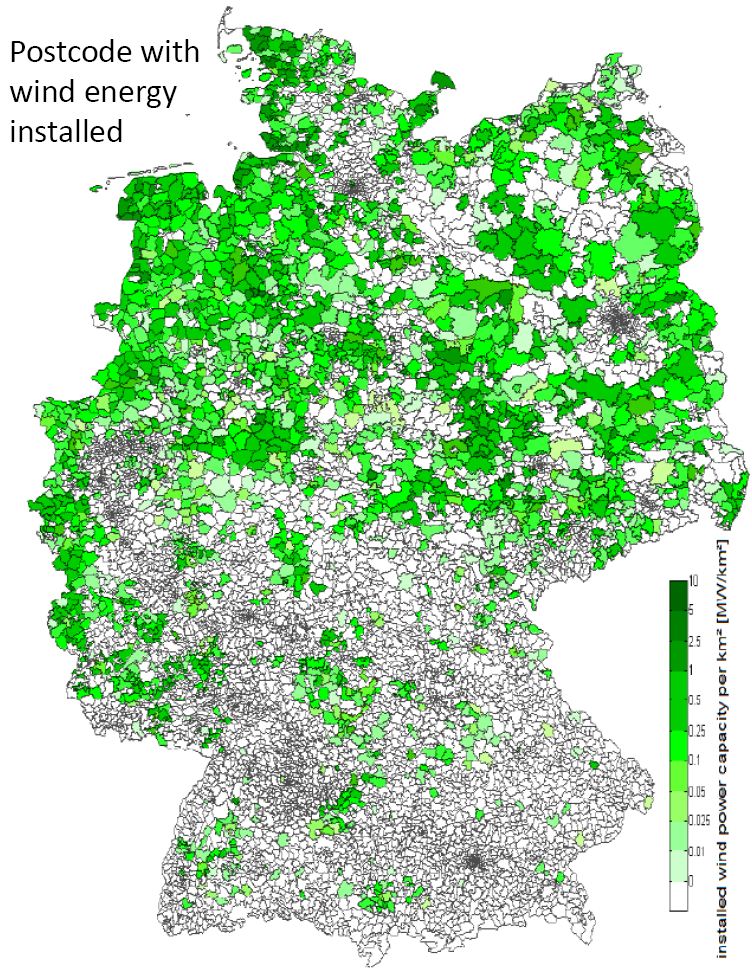
Fig. 1: Distribution of windmills. [12] (Courtesy of dena.)


Introduction

On June 30th 2011 83% (513 out of 620) of the German Bundestag voted to forever close all German nuclear power plants, eight immediately and the other nine by 2022. This decision was a direct consequence of the Fukushima nuclear accident, after which the German public was no longer willing to risk the dangers of nuclear energy. [1] This legislation was not a pushed by the left, right, or green special interests. It was clear to all parties that the maintaining the existing plants would cost them the upcoming election. I will not seek to justify that decision in this article; instead I will take that decision as given and discuss the practical realities of maintaining the grid without nuclear power. The German energy transition is a highly complex process and it remains to be seen how much it will cost the German people, if they will maintain their resolve through 2022. Regardless, Germany is now running the experiment, so we can watch and learn.
 

Without Nuclear Energy, What Will Power Germany?

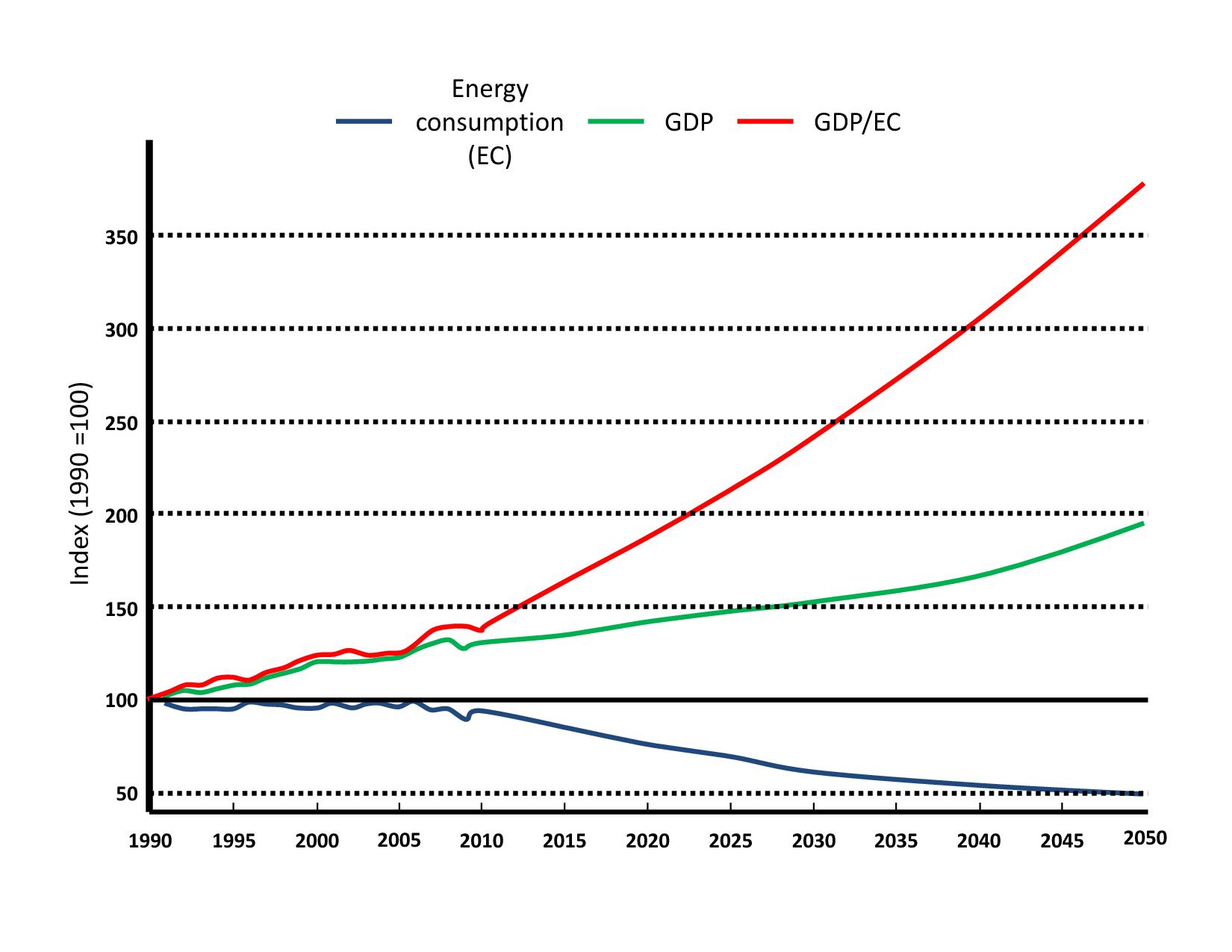
A good place to start when determining the cost of replacement for German nuclear energy is the power output of those soon-to-be decommissioned plants. Table 1 shows various sources of German energy and their total output for 2012. [2] Coal and natural gas are the primary energy sources, but 11% of the energy is generated by nuclear. Therefore, it does not seem unreasonable to replace that nuclear power with either natural gas or coal. However, Germany is quite committed to the Kyoto protocol must therefore fill in that capacity with emission free energy. The government hopes to fill the void with a mixture of wind and photo voltaic renewable energy. To that end, government funds have been used to kick start the wind and solar infrastructure. Furthermore, the government hopes to curtail usage so as to meet the energy deficit. [3] Fig. 2 shows the change in primary energy consumption (EC) compared to the GDP versus time. Primary energy consumption is the sum of household EC, industry EC, traffic EC, system losses and so on. [3] Interestingly, Germany has succeeded in keeping its energy consumption constant while growing GDP from 1990 until 2010, but has been unable to drastically reduce in energy usage. Fig. 2 also shows a future prediction, which assumes high energy savings while still growing GDP. [3] Given that Germany was unable to both reduce EC and grow the GDP over the past 20 years, it is unclear where the energy needed to make up the nuclear deficit should come from.
 
Energy SourceAverage Power [MW]
Waste460
Biomass998
Lignite16831
Gas19757
Nuclear12068
Hydro1894
Multiple Sources10272
Oil3103
Pumped-Storage8876
Solar464
Coal21514
Offshore Wind188
Onshore Wind8863
Miscellaneous1348
Total106636
Table 1: Energy mix of Germany in 2012. [2]

Renewable Energy and Its Challenges


This article does not go into the implementation details of wind or solar power, the interested reader is referred to the web and resources like, which explain how they work. [4-10] However, the implementation of these two energy sources does share one important shortcoming: their dependence on the weather. Without wind and sunshine these two power sources generate no electricity. And since the weather is beyond our control their power output is highly volatile. [2,3] Today wind energy can fluctuate between 0 and 20 GWh. That difference is similar to turning on 20 nuclear power plants in just a few days' time. The existing power grid was not designed for such fluctuations. The addition of solar power further complicates matters. In one day of this past spring German solar plants produced 20 GW in one hour. [11] The absolute size of this one number may be promising in that it proves that there is a large amount of renewable energy available, but it represents a nightmare for the operators of the power grid. Furthermore, the highly volatile renewable energy sources are highly localized. Most wind energy is produced in the north, near the coast or even off-shore (Fig. 1), and must be transmitted to the energy hungry industries of southern Germany. [12] Therefore, the grid must fight two battles: large fluctuations in power output, and massive power transmission. Before these new energy sources neither was an issue.

Updating the Power Grid

Reference [12] investigates three different scenarios for the evolving German power grid, and all of them required substantial expansion of the existing grid. The total length of new power lines that must be built, according to the models, ranges from 1700 to 3600 km and costs between 0.98 billion and 1.64 billion Euros a year (for 10 years). The annual German budget is 313 billion Euros (2012), suggesting that money is not an issue. [13] However, the grid expansion is impractical due to the small villages that cover the German countryside and the homeowners who live there. Germany is a very densely populated country, which means that every new power line must pass thousands of homes. As a result, new power lines are guaranteed to engender costly law suits and political resistance. Germans may not want nuclear power, but they don't want a power line in front of their house either. According to [12] the most practical solution involves 380 kV three-phase overhead power lines, and classical HVDC technology with overhead line transmission where that proves impractical. HVDC is most useful for connecting to offshore wind farms or for directly connecting the north to the south over 600-700 km. The interested reader is referred to [12] which contains more detailed information on the various transmission alternatives, including the principles of operation and their advantages and drawbacks.
 
Fig. 2: Primary energy consumption (EC) of Germany compared to GDP. [3]
Another way to relax the stresses placed on the power grid by renewable energy is through the use of storage, which were investigated by [12] as well. Unfortunately, they conclude that most of today's storage technologies are not compatible with the needs of renewable energy. With the exception of pump storage, no available technology has enough storage capacity to effectively level the variations in renewable energy, and increasing the amount of pump storage is infeasible because all possible sites are either in use already or blocked for environmental reasons. It remains to be seen however, if additional capacity is available in Switzerland, Austria, or Norway.
An interesting solution to the storage problem that was not explored in [12] may be through renewable methane, as reported in [14]. Renewable methane is produced with electricity, which can then be stored in a more traditional manner until needed. The efficiency converting electricity to methane and back is unfortunately low (approx. 38%), but it is better to save that 38% than to throw it away during peak production. As it stands, wind and solar power plants are shut down when production exceeds grid capacity.
 

Summary

In conclusion, it would not be difficult to replace Germany's nuclear power plants with gas or coal, but doing so and remaining carbon neutral is impossible. Wind and solar energy present attractive alternatives, but both suffer from inconsistent weather, which then requires more complicated transmission and storage to utilize properly. It appears to be technologically possible, but it remains to be seen whether the German citizens are willing to pay for the transition. There will be at least two general elections before the last nuclear plant is shut down, which leaves ample opportunity to politicize the subject.
© Martin Kramer. The author grants permission to copy, distribute and display this work in unaltered form, with attribution to the author, for noncommercial purposes only. All other rights, including commercial rights, are reserved to the author.
 

References

[1] "Entwurf eines Dreizehnten Gesetzes zur Änderung des Atomgesetzes," Deutscher Bundestag, Drucksache 17/6246 , 22 Juni 2011 ["Proposed Legislation for a Thirteenth Change to the Atomic Energy Law," German Parliament, Docket 17/6246, 22 Jun 11].
[2] "Bericht zum Zustand der leitungsgebundenen Energieversorgung im Winter 2011/12," Bundesnetzagentur, 3 May 12 ["Report on the Status of the Electric Grid Energy Supply in the Winter of 2011/2012," Federal Electric Grid Agency, 3 May 12].
[3] J. Nitsch et al., "Langfristszenarien und Strategien für den Ausbau der Erneuerbaren Energien in Deutschland bei Berücksichtigung der Entwicklung in Europa und global," Schlussbericht BMU-FKZ 03MAP146 für Bundesministerium für Umwelt, Naturschutz und Reaktorsicherheit, 29 März 2012 ["Long-Term Scenarios and Strategies for the Buildup of Renewable Energy in Germany in the Context of Development in Europe and the World," Final Report BMU-FKZ 03MAP146 to the Federal Ministry for Environment, Nature Conservation and Reactor Safety, 29 Mar 12].
[4] T. Parise, " Wind Turbine Design," PH240, Stanford University, 2011.
[5] M. Shu, "Modern Wind Power," PH240, Stanford University, 2011.
[6] S. Agaian, "Wind Energy: Benefits, Design, and Challenges," PH240, Stanford University, 2011.
[7] A. Aguilar, "Solar Power Conversion," PH240, Stanford Unviersity, 2011 .
[8] F. Abuzaid, "Offshore Wind Energy," PH240, Stanford University, 2010.
[9] J. Brown-Cohen, "Photon-Enhanced Thermionic Emission," PH240, Stanford University, 2010.
[10] C. Bruner, "Organic Photovoltaics," PH240, Stanford University, 2010.
[11] E. Kirschbaum, "Germany Sets New Solar Power Record, Institute Says," Reuters, 26 May 12.
[13] "Abstract of the Federal Ministry of Finance's Monthly Report" German Federal Ministry of Finance, July 2012.
[14] M. Sterner, "Bioenergy and Renewable Power Methane in Integrated 100% Renewable Energy Systems," (Kassel University Press, 2009).

Energy 360 – Nuclear Power: Promise or Peril? [VIDEO]:Stanford Energy Club.

Energy 360 – Nuclear Power: Promise or Peril? [VIDEO]

http://energyclub.stanford.edu/energy-360-nuclear-power-promise-or-peril/

8 December 2012 | News
By admin


This year’s first Energy 360 panel provided an overview of the domestic and international effect of safety issues on policy and future research in nuclear technology. The broad range of perspectives and experiences presented by the panelists provided a multifaceted and thorough discussion of nuclear energy.

During the discussion, the panelists generally agreed that there are certainly risks to pursuing nuclear technology, as there are with most if not all sources of energy, but the optimum way to mitigate these risks is not through the passage of a moratorium on nuclear energy in this country but instead by remaining active and involved in global research in the field.
Future technologies such as fusion and thorium present great potential, but without continued interest and investment of both financial and human resources, this potential might be left unfulfilled. Industry seems to be moving towards smaller and safer nuclear plants, and combined with a conscious effort made to address the concerns of communities, nuclear energy might one day achieve the social acceptance required to represent a major portion of U.S. energy production.
Some concerns that remain unanswered include alternate sources of cooling, such that countries with water deficiency can still pursue nuclear energy, and effective and acceptable waste management for radioactive waste produced through fission reactions.

Moderator:
Dr. Leonard Weiss from Stanford University’s Center for International Security and Cooperation (CISAC)

Panelists:
  • Mike Dunne – Director of Laser Inertial Fusion Energy (LIFE) at Lawrence Livermore National Lab
  • Thomas Isaacs – Director for the Office of Planning and Special Studies at Lawrence Livermore National Lab, and a contributor to the Blue Ribbon Commission’s report discussing proper nuclear waste management
  • Alex Komoroske – Managing director for Ritchie Capital and former licensing and safety engineer for General Electric
A few notable points from the panelists:
  • The best way to ensure national security and international responsibility is to be involved at the forefront of nuclear technology research
  • Social acceptance of nuclear technology is possible, if the government and utilities companies are willing to reach out to the public and listen to their concerns.
  • Small to medium sized reactors (SMR) do not pose as much of a safety concern, and may be a viable source of distributed power
  • Fusion technology poses fewer safety risks than current fission technology, and within 1 – 5 years, we should know whether a breakthrough in this field is feasible or not.
The full panel discussion can be viewed below:


公開日: 2013/02/09
The Technology and Policy behind Safe Nuclear Power

This video documents the event that took place November 27, 2012. The panel examines the outlook for nuclear energy both nationally and internationally, focusing on the effect that safety concerns will have on policy, commercial feasibility, and the direction of research.

Panelists include Mike Dunn, Director of Laser Inertial Fusion Energy at Lawrence Livermore Labs; Thomas Isaacs, Director for the Office of Planning and Special Studies at Lawrence Livermore Labs and an FSI affiliate; and Alex Komoroske, Managing Director at Ritchie Capital Management and previous Licensing and Safety Engineer for Fukushima at GE.

© 2013 Stanford Energy Club. All rights reserved