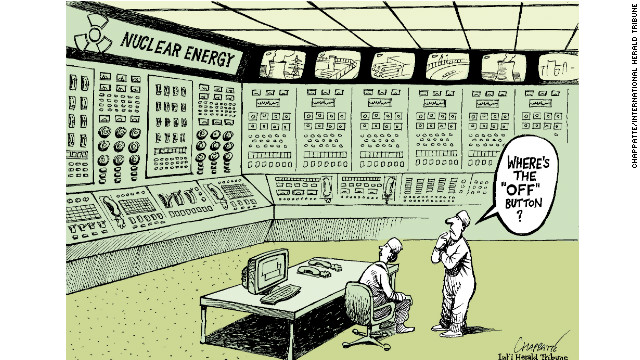
Do you know what he is trying to say?
彼が何を言おうとしているのか、あなたには分かりますか。
Suga will be going to say about
that Shinzou Abe is donkey,monkey,foolish,crazy,or mad.
Which is he?


ABEnoMOX is explosing.


the radioactive contaminated water from Fukushima.

Cf. 放射能汚染水みんなで飲めば怖くない。
Don't mind
ABEnoMICS 1,2,3

アベノミックス 1, 2,3:
1.原子力事故は少しも心配ない。
2.原子力発電の再稼働をしましょう。
3.多くの原子力発電を海外に輸出しましょう。
ABE (no) FOX NEWS
ABE's lie is burning now by the Fukushima Nuclear Radiation.


仏紙が汚染水揶揄の風刺画 官房長官「大変遺憾」(13/09/12)
公開日: 2013/09/12
フランスの風刺画を菅官房長官が「大変、遺憾だ」と批判しました。
French Cartoon Mocks Fukushima Olympics
Worse Than Expected: Fukushima Struggles To Contain Radiation
公開日: 2013/08/06
via ChannelNewsAsia.com / August 5, 2013 / The operator of Japan's crippled Fukushima nuclear plant has given its first public estimate of the size of the leakage of radioactive tritium into the Pacific Ocean since the disaster.
Between 20 trillion to 40 trillion becquerels of the substance is estimated to have leaked into the sea since May 2011, said Tokyo Electric Power Co (TEPCO).
It was the first such figure TEPCO has released since a massive tsunami led to the accident in March 2011, a spokesman said on Sunday.
The disaster sent reactors into meltdown and forced the evacuation of tens of thousands of residents in the worst atomic accident since Chernobyl in 1986.
It was only last month that the embattled operator confirmed long-held suspicions of ocean contamination from the shattered reactors, as Japan's nuclear watchdog cast doubt on the utility's earlier claims that the toxic water was contained in the facility.
But TEPCO said the scale of the radioactive tritium leak, from May 2011 to July 2013, was around the level which had been allowed under safety regulations before the accident — 22 trillion becquerels annually at the six-reactor plant.
The utility said it would also estimate the amount of cancer-causing strontium which may have leaked over the years.
The operator has also said the levels of underground water have risen as workers built shields to prevent groundwater seeping out into the ocean.
The company — which faces huge clean-up and compensation costs — has struggled with a massive amount of radioactive water accumulating as a result of continuing water injections to cool reactors.
A series of problems at the reactor site, including TEPCO's secretiveness, has drawn blunt criticism at home and abroad.
Foreign nuclear experts late last month blasted TEPCO's lack of transparency over radioactive leaks.
"These actions indicate that you (TEPCO) don't know what you are doing... you do not have a plan and that you are not doing all you can to protect the environment and the people," Dale Klein, former head of the US Nuclear Regulatory Commission, told a panel in Tokyo.
http://fukushimaupdate.com/
extra tags: 2012, phenomenon, pole shift, solar flare, nibiru, planet x, conspiracies, prophecy, annunaki, Evidence, Alien hybrid, ancient, top secret, disclosure, Earth Changes, Mayan, end times, doomsday, illuminati, nostradamus, suppressed knowledge, Disaster preparedness, new world order, giants, holy bible, 666, antichrist, reptilian, UFO, ancient texts, conspiracy, nasa, cataclysm, paranormal, ghost, theory, armageddon, survivalism, technology, Alternative history, forbidden knowledge, Anomalies, experiment, experiments, Alien, Aliens, Extraterrestrial, grays, underground bases, Cattle mutilations, ufo, ufos, mystery, myth, Evolution, Education, science, Weird, Bizarre, hybrids, visitations, prophecy, ET, ET's, hollow earth theory, mankind origins, alien agenda, Reptoids, area 51, alien bases, phobos, abduction, ancient aliens, civilizations, lunar base, disclosure, ancient scrolls, discovery channel, history channel, hidden truth, Anomalies, space,conspiracy theories, Mars, Moon, Sun, Mystery, Mayan, news,end times, comet,collision, doomsday, civilization, Armageddon, chaos, secret knowledge, Solar System, black hole, mass extinctions, universe, cataclysm,tsunami, humanity, catastrophe, survival death, obe, nde, bio warfare, tornado, hurricane, haarp, superstorm, dwarf star, orbit, questions, answers, information, mankind, social collapse, government agenda, super storm, economic collapse, Mystery Booms, Black Eyed Children, NWO, Bilderberg, Obama, JFK, moon landing hoax, crop circles, Time Travel, angels, demons,religion, Nephilim, Reincarnation, Astrology, UFO Disclosure, UFO crash, Cryptozoology, Vampires, Werewolves, Zombies, Dreams, Human Psyche, ESP, PSI, Spirit, Economy, Military, War, Terrorism, Politics, World Events, Occult, Secret Societies, Bigfoot, Mothman, Alantis, Magic, Stargates, Numerology, Universe, pyramids, remote viewing
Between 20 trillion to 40 trillion becquerels of the substance is estimated to have leaked into the sea since May 2011, said Tokyo Electric Power Co (TEPCO).
It was the first such figure TEPCO has released since a massive tsunami led to the accident in March 2011, a spokesman said on Sunday.
The disaster sent reactors into meltdown and forced the evacuation of tens of thousands of residents in the worst atomic accident since Chernobyl in 1986.
It was only last month that the embattled operator confirmed long-held suspicions of ocean contamination from the shattered reactors, as Japan's nuclear watchdog cast doubt on the utility's earlier claims that the toxic water was contained in the facility.
But TEPCO said the scale of the radioactive tritium leak, from May 2011 to July 2013, was around the level which had been allowed under safety regulations before the accident — 22 trillion becquerels annually at the six-reactor plant.
The utility said it would also estimate the amount of cancer-causing strontium which may have leaked over the years.
The operator has also said the levels of underground water have risen as workers built shields to prevent groundwater seeping out into the ocean.
The company — which faces huge clean-up and compensation costs — has struggled with a massive amount of radioactive water accumulating as a result of continuing water injections to cool reactors.
A series of problems at the reactor site, including TEPCO's secretiveness, has drawn blunt criticism at home and abroad.
Foreign nuclear experts late last month blasted TEPCO's lack of transparency over radioactive leaks.
"These actions indicate that you (TEPCO) don't know what you are doing... you do not have a plan and that you are not doing all you can to protect the environment and the people," Dale Klein, former head of the US Nuclear Regulatory Commission, told a panel in Tokyo.
http://fukushimaupdate.com/
extra tags: 2012, phenomenon, pole shift, solar flare, nibiru, planet x, conspiracies, prophecy, annunaki, Evidence, Alien hybrid, ancient, top secret, disclosure, Earth Changes, Mayan, end times, doomsday, illuminati, nostradamus, suppressed knowledge, Disaster preparedness, new world order, giants, holy bible, 666, antichrist, reptilian, UFO, ancient texts, conspiracy, nasa, cataclysm, paranormal, ghost, theory, armageddon, survivalism, technology, Alternative history, forbidden knowledge, Anomalies, experiment, experiments, Alien, Aliens, Extraterrestrial, grays, underground bases, Cattle mutilations, ufo, ufos, mystery, myth, Evolution, Education, science, Weird, Bizarre, hybrids, visitations, prophecy, ET, ET's, hollow earth theory, mankind origins, alien agenda, Reptoids, area 51, alien bases, phobos, abduction, ancient aliens, civilizations, lunar base, disclosure, ancient scrolls, discovery channel, history channel, hidden truth, Anomalies, space,conspiracy theories, Mars, Moon, Sun, Mystery, Mayan, news,end times, comet,collision, doomsday, civilization, Armageddon, chaos, secret knowledge, Solar System, black hole, mass extinctions, universe, cataclysm,tsunami, humanity, catastrophe, survival death, obe, nde, bio warfare, tornado, hurricane, haarp, superstorm, dwarf star, orbit, questions, answers, information, mankind, social collapse, government agenda, super storm, economic collapse, Mystery Booms, Black Eyed Children, NWO, Bilderberg, Obama, JFK, moon landing hoax, crop circles, Time Travel, angels, demons,religion, Nephilim, Reincarnation, Astrology, UFO Disclosure, UFO crash, Cryptozoology, Vampires, Werewolves, Zombies, Dreams, Human Psyche, ESP, PSI, Spirit, Economy, Military, War, Terrorism, Politics, World Events, Occult, Secret Societies, Bigfoot, Mothman, Alantis, Magic, Stargates, Numerology, Universe, pyramids, remote viewing
=======================================================================
Fukushima: Japan's Apocalypse Now!
公開日: 2013/08/19
Stephen Lendman writes:
Japan's apocalypse continues. Emergency conditions persist. No end in sight looms. Fukushima's radioactive discharges can't be stopped. They continue. They're uncontainable.
At issue is by far the worst environmental disaster in history. It's multiples worse than Chernobyl. It's an unprecedented catastrophe. It's reason enough to abolish nuclear power.
According to Japan's Ministry of Economy, Trade and Industry, about 300 tons of radioactive groundwater flow into the Pacific daily.
It's done so since Japan's March earthquake and tsunami triggered Fukushima's meltdown.
Tokyo Electric (TEPCO) says water's getting over and around "chemical walls." It can't be stopped. Three Fukushima reactors suffered meltdowns. A fourth was badly damaged.
The worst fear remains. Unit Four's structural integrity was seriously undermined. It contains hundreds of tons of highly radioactive water.
read more: http://www.popularresistance.org/fuku...
tags
Fukushima, Emergency, Radioactive water, radioactive fish, Nuclear meltdown Radioactive discharge, radioactive, Tokyo Electric, TEPCO, Nuclear power, nuclear energy, radioactive waste, Stephen Lendman, Helen Caldicott, Popular Resistance, Resistance Report, popularresistance.org, Acronym TV, Dennis Trainor Jr, TYT, atv
Subscribe - http://bit.ly/VUl21B
Twitter: http://www.twitter.com/dennistrainorjr
facebook: http://www.facebook.com/acronymwithdt...
Web http://www.acronymtv.com
Japan's apocalypse continues. Emergency conditions persist. No end in sight looms. Fukushima's radioactive discharges can't be stopped. They continue. They're uncontainable.
At issue is by far the worst environmental disaster in history. It's multiples worse than Chernobyl. It's an unprecedented catastrophe. It's reason enough to abolish nuclear power.
According to Japan's Ministry of Economy, Trade and Industry, about 300 tons of radioactive groundwater flow into the Pacific daily.
It's done so since Japan's March earthquake and tsunami triggered Fukushima's meltdown.
Tokyo Electric (TEPCO) says water's getting over and around "chemical walls." It can't be stopped. Three Fukushima reactors suffered meltdowns. A fourth was badly damaged.
The worst fear remains. Unit Four's structural integrity was seriously undermined. It contains hundreds of tons of highly radioactive water.
read more: http://www.popularresistance.org/fuku...
tags
Fukushima, Emergency, Radioactive water, radioactive fish, Nuclear meltdown Radioactive discharge, radioactive, Tokyo Electric, TEPCO, Nuclear power, nuclear energy, radioactive waste, Stephen Lendman, Helen Caldicott, Popular Resistance, Resistance Report, popularresistance.org, Acronym TV, Dennis Trainor Jr, TYT, atv
Subscribe - http://bit.ly/VUl21B
Twitter: http://www.twitter.com/dennistrainorjr
facebook: http://www.facebook.com/acronymwithdt...
Web http://www.acronymtv.com
Radioactive Water From Fukushima Nears Pacific
公開日: 2013/08/23
Contaminated water leaking from the Fukushima nuclear power station is the most serious incident to plague the crippled plant since its meltdown in March 2011 and may derail Japan's bid for the 2020 Olympic games. (Aug. 23)
BBC News - Fukushima radioactive water leak an 'emergency'
公開日: 2013/08/05
Japan's nuclear watchdog has said the crippled Fukushima nuclear plant is facing a new "emergency" caused by a build-up of radioactive groundwater.
A barrier built to contain the water has already been breached, the Nuclear Regulatory Authority warned.
This means the amount of contaminated water seeping into the Pacific Ocean could accelerate rapidly, it said.
Emily Thomas reports.
=======================================================================
=======================================================================
http://www.popularresistance.org/there-is-no-way-to-stop-fukushima-radioactive-water-leaking-into-the-pacific-expert/
There is No Way to Stop Fukushima Radioactive Water Leaking Into the Pacific - Expert
 Educate! Fukushima, Nuclear Energy
By Evgeny Sukhoi, www.voiceofrussia.com
August 11th, 2013
The rate at which contaminated water has been pouring into the Pacific Ocean from the disabled Fukushima nuclear plant is worse than previously thought, an Industry Ministry official said Wednesday as PM Shinzo Abe pledged to step up efforts to halt the crisis. The Voice of Russia contacted Arnold Gundersen, founder and president of Fairewinds Associates, to discuss the crisis and its possible solutions. The expert suggests radioactive material will continue to leak into the global seas unless the plant is surrounded with a trench filled with zeolite. Even then however, toxic material will still flow into the Pacific through underwater routes.
radioactive-water-leaking-into-the-Pacific-expert-5360/
=======================================================================
Donkey 菅義偉 (Yoshihide Suga)A barrier built to contain the water has already been breached, the Nuclear Regulatory Authority warned.
This means the amount of contaminated water seeping into the Pacific Ocean could accelerate rapidly, it said.
Emily Thomas reports.
=======================================================================
=======================================================================
http://www.popularresistance.org/there-is-no-way-to-stop-fukushima-radioactive-water-leaking-into-the-pacific-expert/
There is No Way to Stop Fukushima Radioactive Water Leaking Into the Pacific - Expert
By Evgeny Sukhoi, www.voiceofrussia.com
August 11th, 2013
The rate at which contaminated water has been pouring into the Pacific Ocean from the disabled Fukushima nuclear plant is worse than previously thought, an Industry Ministry official said Wednesday as PM Shinzo Abe pledged to step up efforts to halt the crisis. The Voice of Russia contacted Arnold Gundersen, founder and president of Fairewinds Associates, to discuss the crisis and its possible solutions. The expert suggests radioactive material will continue to leak into the global seas unless the plant is surrounded with a trench filled with zeolite. Even then however, toxic material will still flow into the Pacific through underwater routes.
Is it possible to somehow make the wastewater storage basins waterproof and thus rule out leakage?
The horse is already out of the barn here. This plant’s been leaking for two years. And finally, now, the radioactive water has made it to the ocean. But my experience with underground water is that – if it is serious at the ocean, it is more serious as you move away from the ocean. So, spike of radiation continues to move to the ocean.
The Japanese are proposing putting in a barrier to prevent the water from entering the ocean. That is two years too late and will be too late by the time they construct that barrier. But the barrier also causes another problem. If the water can’t go anywhere into the Pacific Ocean, it is going to build up onsite, which means that the nuclear reactors themselves will become unstable. The water can pull underneath the nuclear buildings and if there is an earthquake, in fact the nuclear buildings could topple. So, by solving one problem, they are creating another problem.
Is it possible to somehow avoid that scenario?
The solution that I proposed two years ago was to surround the plant with a trench filled with material called zeolite. That’s just the volcanic ash. The volcanic ash is very good at absorbing radiation. But the solution isn’t to keep the water from getting out. The solution is to keep the water from getting in. So, outside the trench that they surround the plant, if they pull the water level down (the clean water outside the trench) that would prevent further water from leaking into the Daiichi site.
The japans haven’t been willing to spend the money. I approached them two years ago with this and I was told that Tokyo Electric doesn’t have the money to spend. But of course, the problem now is that we are contaminating the Pacific Ocean which is extraordinarily serious.
Is there anything that can be done with that, I mean with the ocean?
Frankly, I don’t believe so. I think we will continue to release radioactive material into the ocean for 20 or 30 years at least. They have to pump the water out of the areas surrounding the nuclear reactor. But frankly, this water is the most radioactive water I’ve ever experienced. I work directly over a nuclear reactor cores during refueling outages. And the water directly over a nuclear reactor core when the plant is operating is a thousand times less radioactive than this water. So, there is an extraordinary amount of water and even if they build the wall, ground waters enter the Pacific through underwater sources. It doesn’t have to run of the top of the surface into the Pacific. It can enter the underwater sources as well.
Domestically, do you expect the latest disclosures about Fukushima to delay decisions on reactivating Japanese nuclear power plants?
I think it should. I think the big problem is that the Japanese Government has not been honest with its people about the cost to clean up Daiichi. I think the cost to clean up just the site is going to be $100 billion. And the cost to clean up the prefecture of Fukushima is going to be another $400 billion.
The Japanese Government hasn’t told the people that they are on the hook for a half a trillion dollars. And I think if the japans people understood the magnitude of the damage a nuclear plant can create, they’d have had second thought about staring up the remaining nuclear plants because it could happen elsewhere. This is the most seismic place on the planet and to build a nuclear plant there is rather foolish.
Read more: http://voiceofrussia.com/2013_08_07/There-is-no-way-to-stop-Fukushima-radioactive-water-leaking-into-the-Pacific-expert-5360/
Read more: http://voiceofrussia.com/2013_08_07/There-is-no-way-to-stop-Fukushima-radioactive-water-leaking-into-the-Pacific-expert-5360/
radioactive-water-leaking-into-the-Pacific-expert-5360/
=======================================================================
http://matuoka777isenokamikaze.blogspot.jp/2013/09/donkey.html
=======================================================================
海外の風刺画に見る日本の汚染水問題
Cf. :
The issue of the radioactive contaminated water of Fukushima Nuclear accident to watch in some overseas caricatures.
http://matuoka777isenokamikaze.blogspot.jp/2013/09/blog-post_15.html
=======================================================================
=======================================================================
http://www.portent.com/blog/internet-marketing/3-common-leadership-pitfalls-to-avoid-at-all-costs.htm
3 Common Leadership Pitfalls to Avoid at All Costs
May 3, 2013 in Internet Marketing
Conventional wisdom dictates that working in teams is often the best way to accomplish a task. Many hands make light work, a bundle of sticks cannot be broken, etc.
Particularly with large, complex projects, there is just no way one person can accomplish everything on their own. We can’t possibly know everything, or be experts in everything, or be talented at everything. And believe me, I’ve tried.
A good leader pulls together their A team –people whose combined skills and expertise can achieve really big goals. But being a leader, and a good one to boot, isn’t easy. If you are an account strategist like me, or a project manager, marketing manager, etc., you know what I mean.
A lot of my leadership philosophy was forged by experiences in the backcountry. I’m a proud NOLS (National Outdoor Leadership School) grad, and have guided backpacking and hiking trips for various organizations, as well as spent many hours, weekends, and weeks on trips in the wilderness.
Leading groups in the wilderness is just like leading marketing project teams – only in the office, it’s unlikely my leadership mistakes will put anyone in grave danger. But mistakes in the office can endure beyond those of a day or weekend hike, and can potentially result in lost revenue, lost clients, or simply lost credibility, internally or externally.
I’m happy to share with you some of the leadership pitfalls I’ve stepped into, both in the office and the backcountry, analyze why we often fall into them, and suggest some ways you can avoid them. But I’m sure you’ve never done any of these before:
1. Being too early out of the gate
At the beginning of a project, your team is often like a pack of racehorses behind the starting gate, chomping at the bit, raring to go.They’ve received the SOW, creative brief, or project outline, and they want to dive in and get started on their work. But, oddly enough, your job as the leader is to hold them back. They’re not yet ready to function as a cohesive unit. It’s also your job to paint the picture of what the work will look like, what steps are necessary to achieve the goals, what role each person will play, and the ideal result. You’re selling the dream.
Business experts define the process teams go through as forming, storming, norming, and performing. Note that forming comes first, followed by storming, then norming – you’re not getting to performing for a while, get it? Allow for that. Build in time for that.
Forming is the critical stage where team members are figuring each other out and learning each other’s quirks (particularly with a new team). This is also the stage in which everyone is generally being nice, but not saying what they really think. A leader needs to ask questions, motivating the team to open up and discuss their expectations.
Storming is where reality sets in – people realize they may not like the plan or each other; they may question the goals, or their role on the team.
Gradually, you’ll reach the norming phase – tasks have been assigned, roles defined, and goals set. It’s beginning to look like everyone is on board. They respect your role as leader, and they believe the goals you’ve set are attainable.
Finally you can begin to think about opening that gate and performing as one amazing unit with a shared vision and goal.
During my NOLS training course, I had the opportunity to lead the first solo (without guides) trek in the backcountry. We’d had other opportunities to lead, but this was the first situation where no guide would be present to bail us out if something went wrong. The guides gave us our destination and two minutes later, I set us off on the trek.
I quickly realized I’d made one of the cardinal mistakes of leadership – I had allowed my team’s excitement to provoke me into starting prematurely. We’d received training in map and compass reading, wilderness first aid, leadership, and traversing tough terrain, and with fantasies of Bear Grylls and “Survivor” in our heads, we thought we were hot stuff.
About twenty minutes into the hike, I realized we were going the wrong way.
Not only that, but the decision put my leadership in question, and mutiny (in the form of bickering about which direction to go) set in. We survived, but there were some tense moments that could have been avoided had I spent 10 minutes at camp getting the group’s goals in alignment and establishing myself as the team lead before setting out on our adventure.
2. Failing to check assumptions
One of the easiest mistakes for leaders to make is assuming everyone thinks like we do. Why wouldn’t they, right? Haha, hmmm…yeah. Believe me, they don’t.You might think everything is going great because the project is ahead of schedule, the client (or your boss) is happy, and conversions are way up – but meanwhile, your team may feel completely overwhelmed, stressed about expectations, and wanting to quit. How can this be?
You might think your client loves hearing the scintillating history of search engines on every single call – after all, it’s fascinating to you and they seem to be listening so attentively. But they may be thinking: “if she brings that up one more time, I’m going to go ballistic.” How can this be?
We are all unique creatures, with our own special take on the world. Assuming others think or operate the way we do will cause nothing but grief, and some (hopefully hilarious?) misunderstandings.
“Assuming” is one of the easiest traps a leader can fall in to, so how can you sidestep it?
Even if you think something is obvious, check the assumption.
Ask your client and your team (frequently) how things are going for them, and if they feel like their goals are being met. Do they have what they need? Is there anything going on in their organization or with other projects that you should know about? Do they feel like you are being responsive to their requests? Does your team understand your client’s goals?
Ask your client and your team what their biggest priority is. Reiterate your understanding of the objectives and blatantly ask if they are in agreement. The answers could easily surprise and amaze you. And what you don’t know CAN hurt you. People can quit (or complain to your boss), clients can fire you, and morale can suffer.
One of the mistakes I made in my debut as a trek guide on the NOLS course was assuming that everyone on my team valued speed over everything else. Why did I think everyone else felt that way? Because my friend and I both thought our trek should be more like the “Amazing Race,” where two teams compete to see which team can get to the X on the map first. We were two people out of seven in the group, but because we both felt this way, I assumed everyone else did too.
Consequently, as the lead of this group, I ran us at a breakneck pace over rocks, up steep terrain, through rivers, with 40-50 pound packs on our back, never once considering that this wasn’t fun for everyone else (particularly the guy who was recovering from a nasty cold).
I didn’t realize it until mutiny set in once again. Oh? Some people wanted to take a more leisurely pace, take pictures of wildflowers, breathe in the fresh mountain air, and chit chat as we strolled along? It never occurred to me. How could this be? I never asked what anyone wanted to get out of this experience. I didn’t check the assumption that everyone thought like me, that a trail run would be awesome. Humph.
3. Being too nice
This one is hard, particularly for those of us who are naturally social, as account strategists and marketing people often are. I really like people and I like being friendly – that’s why I have the job I do. I want people to like me back. The reality is, not everyone will, and particularly not those people to whom you assign tasks, direct work, or otherwise “order around.”If you’re concerned about whether or not your team (or even your client) likes you, you’re probably ignoring something very important: the necessity of setting good boundaries.
Your role as a leader is to define roles, set objectives, plan steps to achieve those objectives, and motivate your team to deliver. Sometimes you have to make tough decisions regarding balancing the needs of your boss or client with the needs of the individuals on your team. If you are worried about being perceived as being friendly, you’re not going to be able to do your job well. And sometimes just the perception of being “too nice” can work against you. People may see you as a pushover, even if you’re far from it.
So how do you avoid this trap?
- Don’t avoid confrontation. Sometimes people will test your boundaries to see how far they can push you. If someone on your team is continually asking for more time to deliver a report, or continually making excuses for mistakes, call them out on it.
- Set a clear expectation for timeliness and quality of work and let them know what the repercussions will be. There’s no need to be unfriendly, but setting clear boundaries can help minimize the perception that your friendliness can be taken advantage of. Sometimes your boss or a client will keep piling on the requests until you say no. Yes, confrontation can be uncomfortable in the moment, but clearly and concisely setting the boundary about what is permissible will work for you in the long run.
- And don’t apologize for things that aren’t your fault. The more you stand up and own your role as a leader, the more your team and others will perceive you that way.
On backpacking trips, your group often shares the weight of group equipment, such as parts to the tent, cooking equipment, first aid supplies, and food. This is generally distributed according to weight and bulk. Bigger people can generally carry more weight, so their packs tend to be heavier. If you’re willing to carry a heavier load proportionally than team members twice your size, and don’t speak up, don’t cry about it later when you are exhausted.
Know your limits, and speak up before you reach them. Being a hero won’t make you a better leader. Teaching your team members (and your clients!) how to carry their own weight will work better for everyone in the long run.
I hope you’ve learned a few tricks for avoiding some common pitfalls of leadership, or at least enjoyed watching me poke fun at my own errors. Often we don’t learn what TO do until we first learn what not to do.
And luckily I never actually lead my NOLS group off a cliff. I just created disharmony, exhausted them, and exhausted myself. And after that experience, I learned what traps to look out for in my marketing team leadership adventures.

Lisa Sali / @lisaesali
Account Strategist
Account Strategist
A seasoned account strategist with expertise in email marketing, online media (performance and display), direct response TV media and beyond, Lisa is a natural problem-solver, passionately committed to her clients. When she’s not building brands on the web, Lisa enjoys yoga and kiteboarding.
=======================================================================